Eigenvectors and eigenvalues
What makes a vector an eigenvector?
An eigenvector is a nonzero vector that stays on the same line after multiplication by A. The corresponding eigenvalue λ records how that vector is scaled or reversed. The chapter compares this behavior across many common two-dimensional transformations, including matrices with no real eigenvectors.
Key ideas
Eigenvectors identify the directions in which a matrix acts by simple scalar multiplication.
- A nonzero vector x is an eigenvector of A when Ax = λx
- Positive λ preserves the vector direction, negative λ reverses it and λ = 0 collapses it to the origin
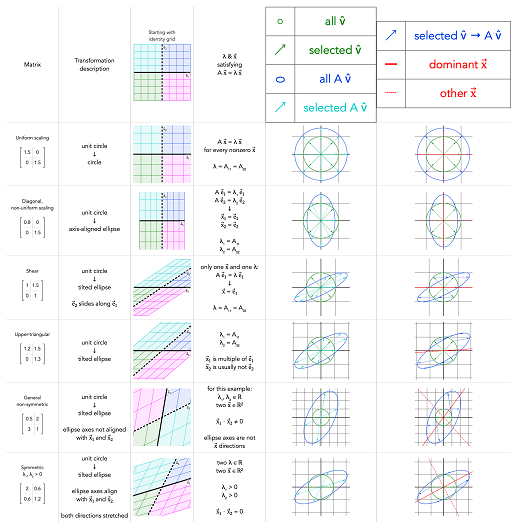
- Uniform scaling makes every nonzero vector an eigenvector
- Diagonal scaling, shear, triangular and general real matrices preserve only selected real directions
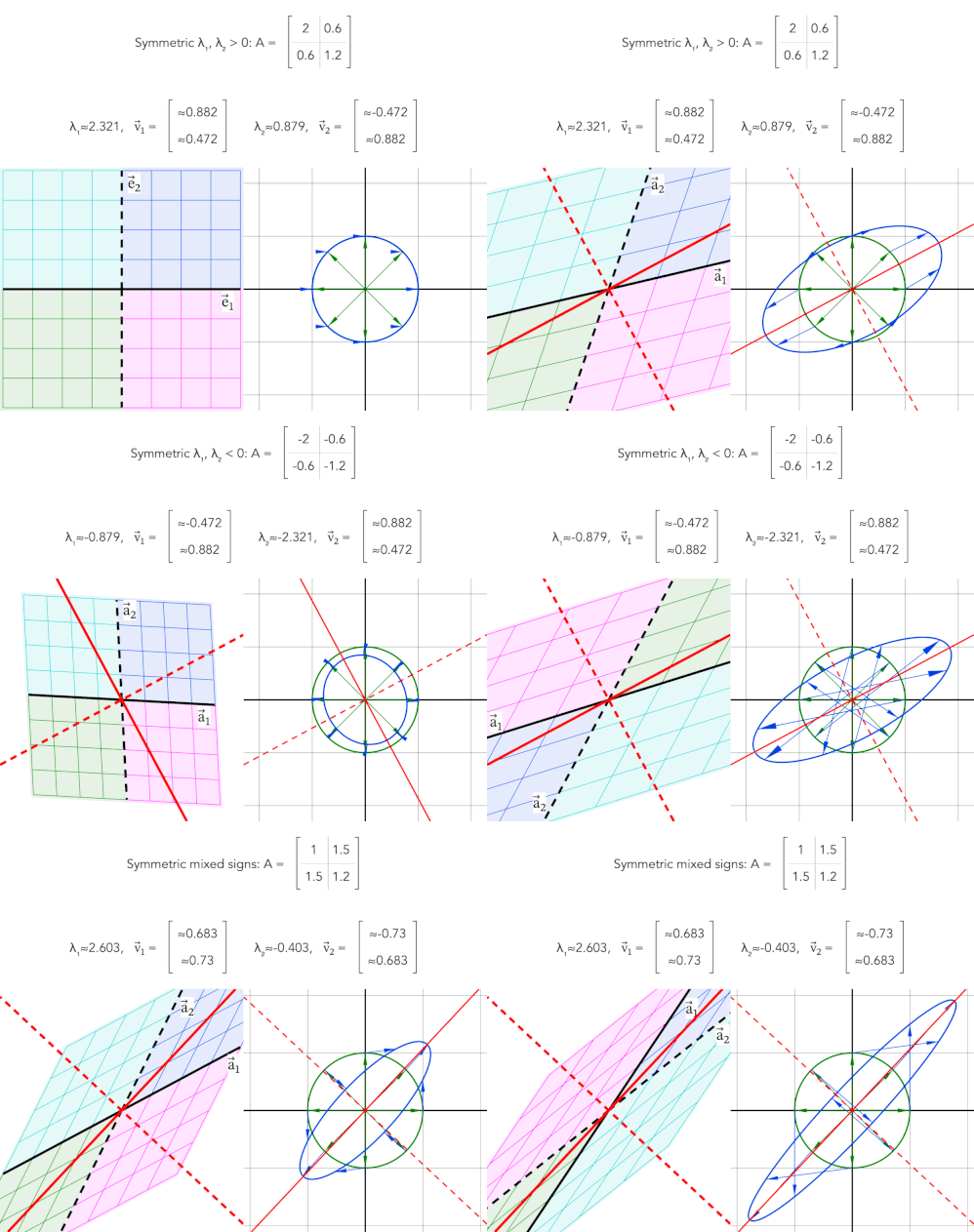
- Real symmetric matrices have orthogonal eigenvector directions
- Projection has eigenvalues 1 and 0; reflection has eigenvalues 1 and −1
- Rotation, rotation-scaling and other matrices with complex eigenvalues may have no real eigenvector direction
- For M(t) = (1 − t)I + tA, every eigenvector of A remains an eigenvector while its eigenvalue changes linearly from 1 to λ
The large comparison table shows the original grid, transformed grid, eigenvector directions and the images of selected vectors for each matrix type.
What does Ax = λx mean geometrically?
The transformed vector Ax lies on the same line as x. The eigenvalue λ determines its length and orientation: |λ| gives the scaling factor, while the sign of a real λ determines whether the direction is preserved or reversed. When no nonzero real vector satisfies the equation, the matrix has no real eigenvector direction.
Related chapters
Examples with visualizations
Eigenvectors — definition and examples
Eigenvector directions across scaling, shear, symmetric matrices, projection, reflection, rotation and other 2D transformations
Eigenvectors and eigenvalues in 2D transformations
Animated comparisons of non-symmetric matrices with real eigenvalues, symmetric matrices with orthogonal eigenvectors and transformations with complex eigenvalues
Chapter contents
The PDF page links below are best-effort: most browsers support them, but some viewers may ignore the page hint.
| Topic | Pages |
|---|---|
| Definition and examples | 1–4 |
| Interpolating the matrices for animations | 4–5 |
What happens to an eigenvector during interpolation from I to A?
For M(t) = (1 − t)I + tA, an eigenvector x of A remains an eigenvector of every intermediate matrix: M(t)x = (1 − t + tλ)x. Its direction therefore stays fixed while its eigenvalue follows λ(t) = 1 + t(λ − 1), moving linearly from 1 to λ. If λ < 0, the vector shrinks to zero and then reappears in the opposite direction.