Complex eigenvalues and eigenvectors
What geometric structure replaces real eigendirections?
A real 2×2 matrix with complex eigenvalues has no nonzero real eigenvector direction. Instead, one complex eigenvector provides two real vectors, Re(x) and Im(x), that form a basis in which the matrix becomes a rotation-scaling block. This gives the factorization A = XSX⁻¹ and makes powers and exponentials of A easier to understand.
Key ideas
Complex eigenvalues of a real matrix occur in conjugate pairs and encode rotation together with scaling.
- For a real 2×2 matrix, non-real eigenvalues occur as λ₁ = α + iβ and λ₂ = α − iβ
- If Ax₁ = λ₁x₁, then x₁ᶜ is an eigenvector associated with λ₂
- A complex eigenvector can be written uniquely as Re(x) + i Im(x)
- Different free-variable choices change the displayed real and imaginary parts without changing the eigenvector relation
- For a rotation-scaling matrix, Re(x) and Im(x) are orthogonal and equal in length
- With X = [Re(x) | Im(x)], a real matrix with complex eigenvalues factors as A = XSX⁻¹
- The block S rotates by θ = atan2(β, α) and scales by ρ = √(α² + β²) = |λ|
- Powers satisfy Aᵗ = XSᵗX⁻¹, and matrix exponentials satisfy eᵗᴬ = XeᵗˢX⁻¹
The chapter follows these ideas through symbolic derivations, basis-change diagrams and orbit visualizations.
Why does one complex eigenvector produce a real basis?
Write x = Re(x) + i Im(x) and λ = α + iβ. Separating the real and imaginary parts of Ax = λx shows that A maps the pair [Re(x) | Im(x)] according to a real rotation-scaling matrix S. When these two real vectors are linearly independent, they form the columns of X and give A = XSX⁻¹.
Related chapters
Examples with visualizations
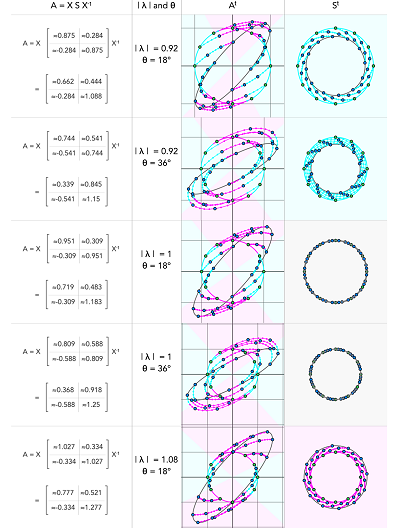
Powers of a 2D Matrix with Complex Eigenvalues
Rotation-scaling factorization and orbit geometry for repeated powers of real 2D matrices with complex eigenvalues
Eigenvectors and Eigenvalues in 2D Transformations
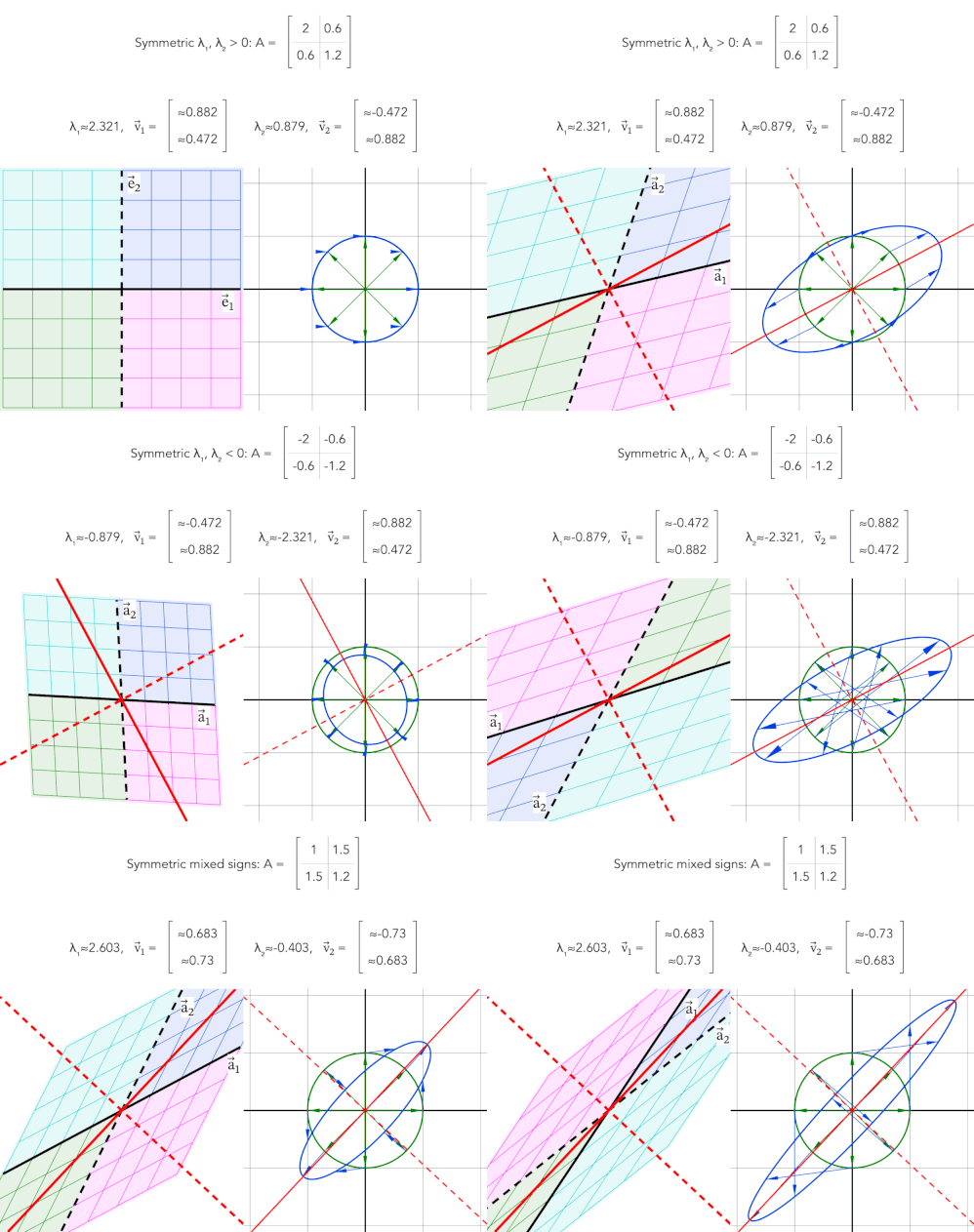
Animated comparisons of non-symmetric matrices with real eigenvalues, symmetric matrices with orthogonal eigenvectors and transformations with complex eigenvalues
Chapter contents
The PDF page links below are best-effort: most browsers support them, but some viewers may ignore the page hint.
How do complex eigenvalues control powers of A?
In A = XSX⁻¹, the matrix S is a rotation-scaling block determined by λ = α + iβ. Its modulus |λ| controls contraction or expansion, while θ = atan2(β, α) controls rotation. Therefore Sᵗ rotates by tθ and scales by |λ|ᵗ, and Aᵗ = XSᵗX⁻¹ carries the same behavior back to the original coordinates. The orbit may appear elliptical in the standard basis even though the underlying action in the S basis is circular.