Diagonalization
What does diagonalization reveal about a transformation?
If A has enough linearly independent eigenvectors, those eigenvectors form a basis in which A acts by independent scalings. The factorization A = CDC⁻¹ first changes to the eigenvector basis, then applies the diagonal matrix D and finally returns to the original coordinates. For a real symmetric matrix, the eigenvectors can be chosen orthonormally and the factorization becomes A = QDQᵀ.
Key ideas
Diagonalization replaces one coupled transformation by separate actions along eigenvector directions.
- If A has a basis of eigenvectors, then A = CDC⁻¹, where the columns of C are eigenvectors and D contains the corresponding eigenvalues
- C⁻¹ changes coordinates to the eigenvector basis, D scales each eigenvector coordinate and C returns to the original basis
- For uniform scaling, every nonzero vector is an eigenvector and any invertible C is valid
- Upper-triangular and general non-symmetric matrices may be diagonalizable even when their eigenvectors are not orthogonal
- A real symmetric matrix can be orthogonally diagonalized as A = QDQᵀ
- For symmetric matrices, the columns of Q are orthonormal eigenvectors and Q⁻¹ = Qᵀ
- A projection has eigenvalues 1 and 0, corresponding to preserved and collapsed directions
- A reflection has eigenvalues 1 and −1, corresponding to fixed and reversed directions
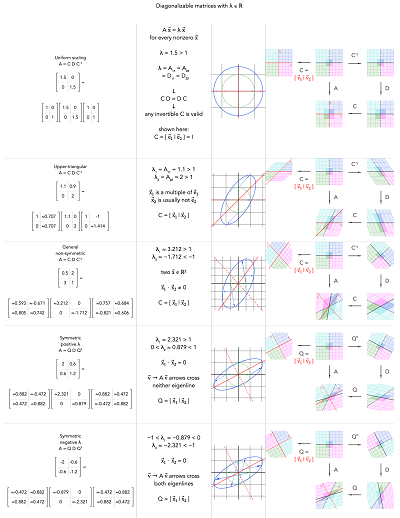
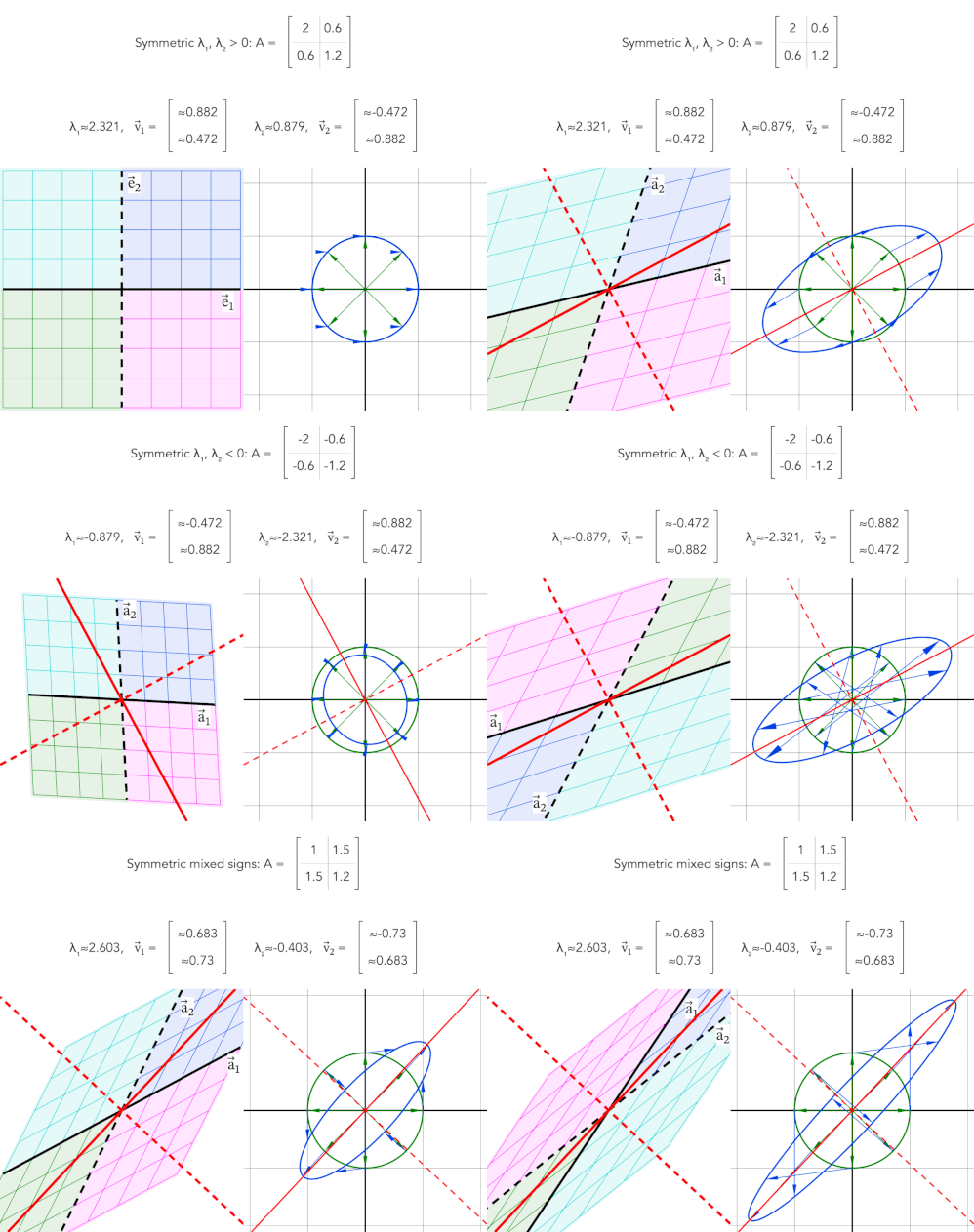
Each example compares the direct action of A with the three-step route through the eigenvector basis.
Why does A = CDC⁻¹ simplify the action of A?
In the standard basis, A may mix the coordinate directions. The matrix C⁻¹ rewrites a vector in the eigenvector basis, where each coordinate lies along an eigenvector. The diagonal matrix D then scales those coordinates independently by their eigenvalues, and C converts the result back. The same transformation is therefore represented as a sequence of a basis change, diagonal scaling and the inverse basis change.
Related chapters
Examples with visualizations
Visual Guide to Diagonalizable 2×2 Matrices
Common diagonalizable 2×2 matrices compared through their geometry, eigenvectors and the factorization A = CDC⁻¹
Eigenvectors and eigenvalues in 2D transformations
Animated comparisons of non-symmetric, symmetric and complex-eigenvalue transformations, including orthogonal eigenvector directions for symmetric matrices
Chapter contents
The PDF page links below are best-effort: most browsers support them, but some viewers may ignore the page hint.
| Topic | Pages |
|---|---|
| Uniform scaling | 1 |
| Upper-triangular | 2 |
| General non-symmetric | 3 |
| Symmetric positive λ | 4 |
| Symmetric negative λ | 5–6 |
| Symmetric mixed-sign λ | 6–7 |
| Projection | 7–8 |
| Reflection | 8–9 |
| Diagonalizable matrices with λ ∈ ℝ | 10–12 |
What is special about orthogonal diagonalization?
For a real symmetric matrix, eigenvectors belonging to distinct eigenvalues are orthogonal and can be normalized to form an orthogonal matrix Q. Because Q⁻¹ = Qᵀ, the general factorization A = CDC⁻¹ becomes A = QDQᵀ. Geometrically, Qᵀ rotates or reflects coordinates into an orthonormal eigenvector basis, D applies independent scalings and Q returns to the original coordinates without introducing shear.