Determinant formulas: permutations and cofactors
How do permutation terms and cofactor expansion describe the same determinant?
The determinant can be written as a signed sum over permutations, or computed recursively by cofactor expansion. These formulas are mostly historical rather than practical for computation, but they reveal how determinant terms are organized by signs, row and column choices, pivots and minor matrices.
Key ideas
Permutation and cofactor formulas are two ways to organize the same signed products.
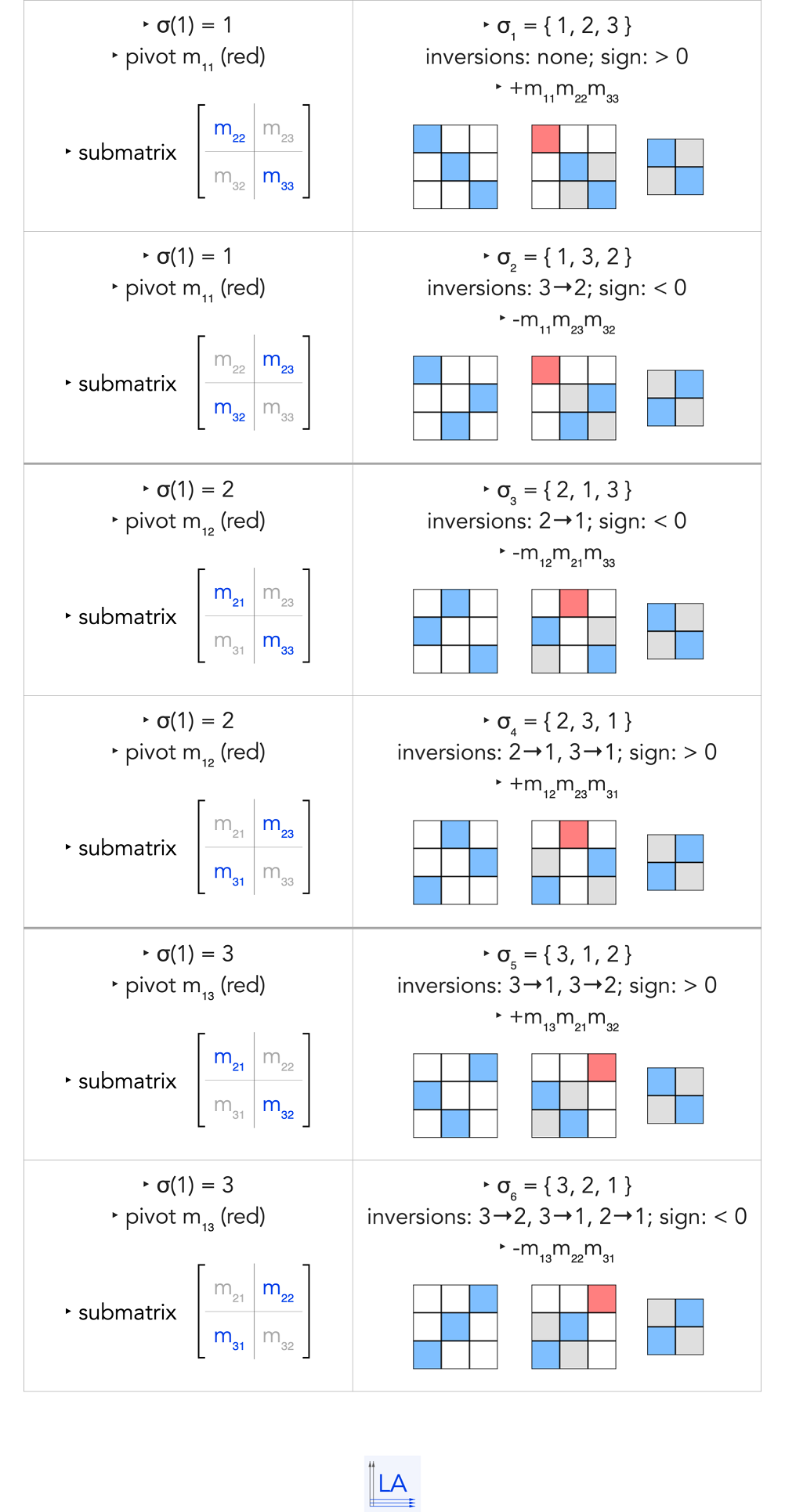
- The permutation formula chooses one entry from each row and one entry from each column
- Each permutation σ contributes one product term, with sign determined by the parity of its inversions
- For a 4×4 matrix, the permutation formula contains 4! = 24 signed terms
- Cofactor expansion fixes a row or column, chooses a pivot and multiplies that pivot by the determinant of the remaining minor
- The cofactor sign alternates according to the position of the pivot
- The same recursive algorithm underlies both viewpoints: choose one element, form the remaining inner set and continue until the base case
- For large matrices, these formulas quickly become impractical, so determinant computation is usually done by row reduction
This chapter is mainly conceptual: it connects the compact determinant formulas with the actual signed products and recursive submatrices they contain.
Why are these formulas not usually used for computation?
The number of permutation terms grows as n!, and cofactor expansion repeatedly creates smaller determinants. This growth is much faster than row-reduction-based computation, so the formulas are mainly useful for understanding determinant structure, not for efficient numerical calculation.
Related chapters
Related visual
Determinant expansion visualized
Permutation terms, pivots, submatrices and cofactor grouping
Chapter contents
The PDF is a single document. The page links below are best-effort: most browsers support them, but some viewers may ignore the page hint.
How do row-operation determinant rules appear in these formulas?
In the permutation formula, swapping rows reverses the sign of every term, scaling a row scales every term and row replacement produces canceling pairs. In cofactor expansion, the same determinant rules are reflected through the alternating cofactor signs and through the determinant of the remaining minor.