Row reduction
What does row reduction preserve, and what does it expose?
Row reduction transforms a matrix or an augmented system into a simpler equivalent form while preserving the solution set. This chapter develops echelon and reduced echelon forms, explains the algorithm through elementary operations and matrices, connects pivots to rank and dependence and shows what echelon form reveals algebraically and geometrically.
Key ideas
Row reduction is not only a solving procedure. It is a structural tool that simplifies a matrix while keeping the important facts unchanged.
- Echelon and reduced echelon forms organize pivots into a staircase pattern that makes dependence and solvability visible
- Elementary row operations preserve the solution set of an augmented system and preserve matrix rank
- Pivot columns mark structurally essential directions, while non-pivot columns mark dependent or redundant ones
- The number of pivots gives rank, so echelon form turns independence into something countable
- Row reduction changes rows by linear combinations, but the pivot positions still reveal which original columns matter
- Elementary matrices show that the whole algorithm can be written as multiplication by invertible transformations
The chapter moves from definitions and mechanics to structure, then ends with numerical considerations and a fully visual 3×3 example.
Why are pivots so important?
Because each pivot marks a new independent direction that survives the reduction process. From those pivot positions we can read rank, constrained variables, free variables and which columns are essential to the span.
Related chapters
Examples with visualizations
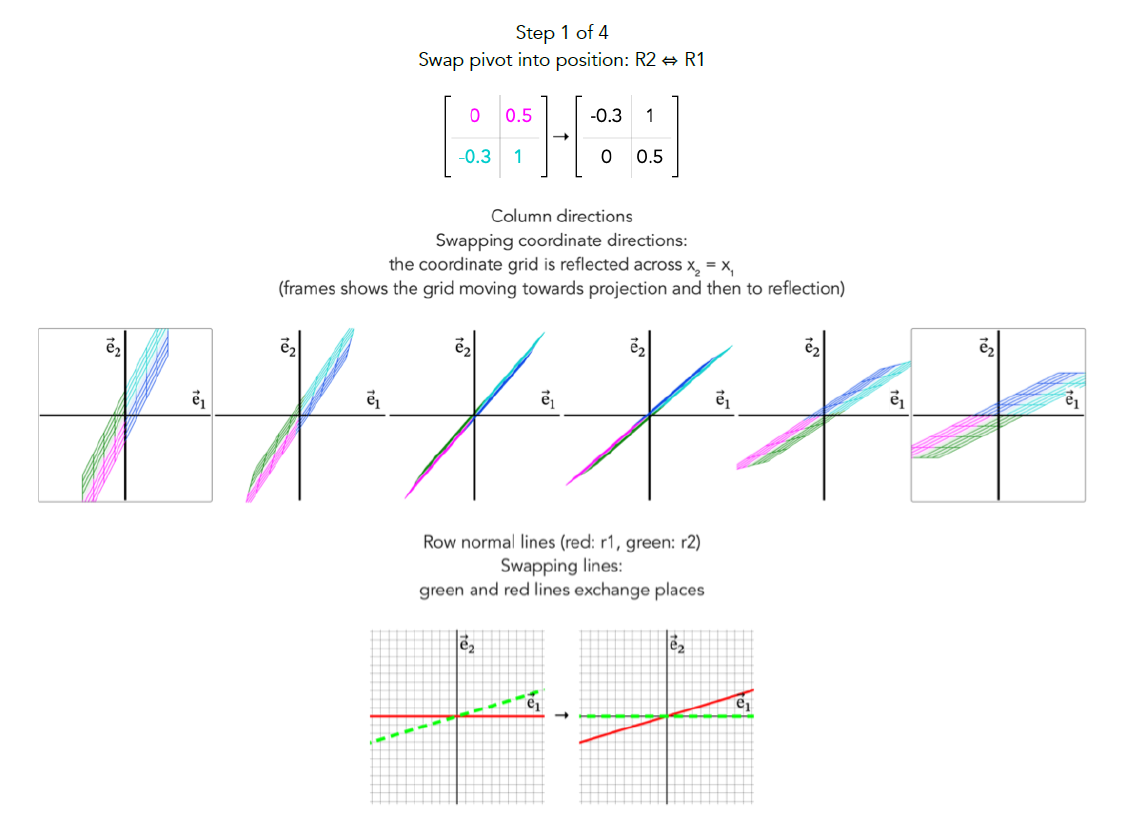
2×2 row reduction example
A step-by-step reduced echelon example with geometric line views
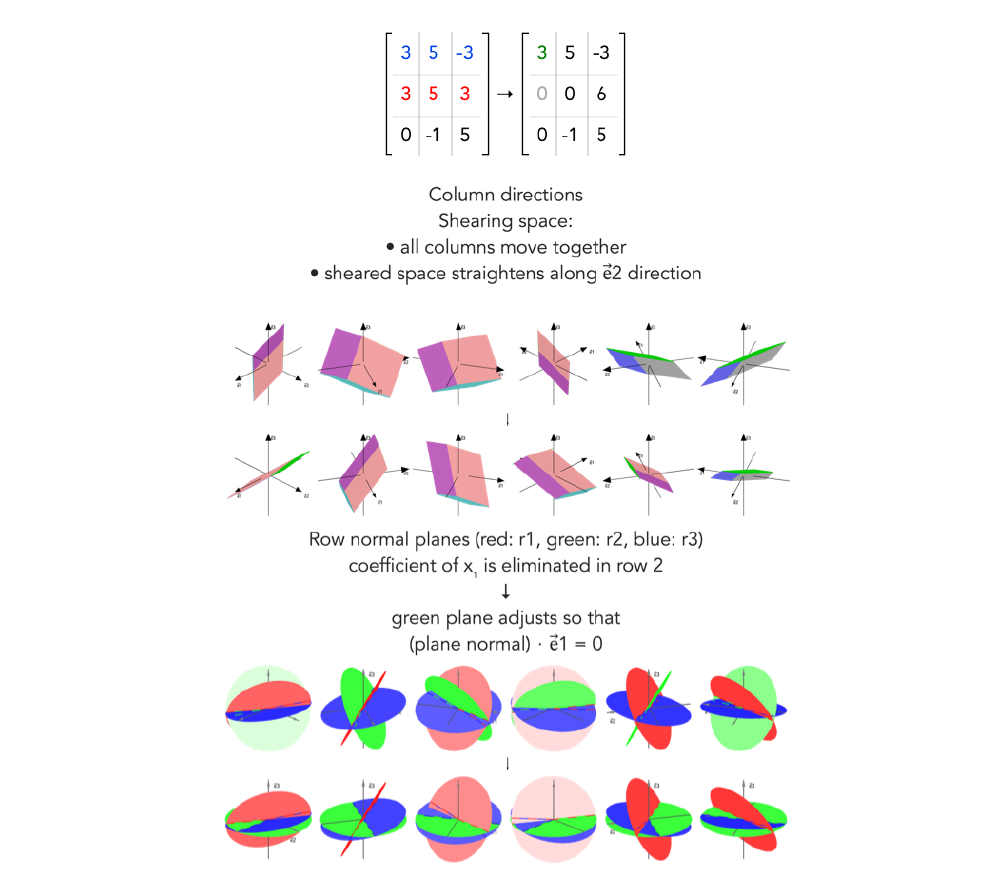
3×3 row reduction example
A step-by-step reduced echelon example with geometric plane views
Chapter contents
The PDF is a single document. The page links below are best-effort: most browsers support them, but some viewers may ignore the page hint.
What does echelon form reveal geometrically?
It shows which vectors contribute new directions and which do not. Pivot columns identify a minimal spanning set, while non-pivot columns reveal vectors that lie in the span of earlier pivot columns.