Determinant
What does determinant measure, and why do row operations reveal it?
Determinant is the signed scaling factor of n-dimensional volume under a square linear transformation. This chapter defines determinant through elementary row operations, derives its main properties, shows how to compute it by row reduction and then connects the algebra to geometric illustrations in 2D and 3D.
Key ideas
Determinant is defined algebraically, but its meaning is geometric: it tracks signed area in 2D, signed volume in 3D and signed n-dimensional volume in general.
- Row swap changes sign, row scaling multiplies determinant by the same scalar and row replacement leaves determinant unchanged
- A non-full-rank square matrix has determinant 0 because its transformation collapses volume into a lower-dimensional shape
- |AB| = |A||B| expresses successive volume scaling under composition of transformations
- The determinant of a triangular matrix is the product of its diagonal entries, which makes row reduction the practical computation method
- Determinant is unchanged by transpose and an orthonormal square matrix has determinant ±1
- Permutation and cofactor formulas are historically important, but they now live in their own companion chapter; row reduction is the preferred computational method
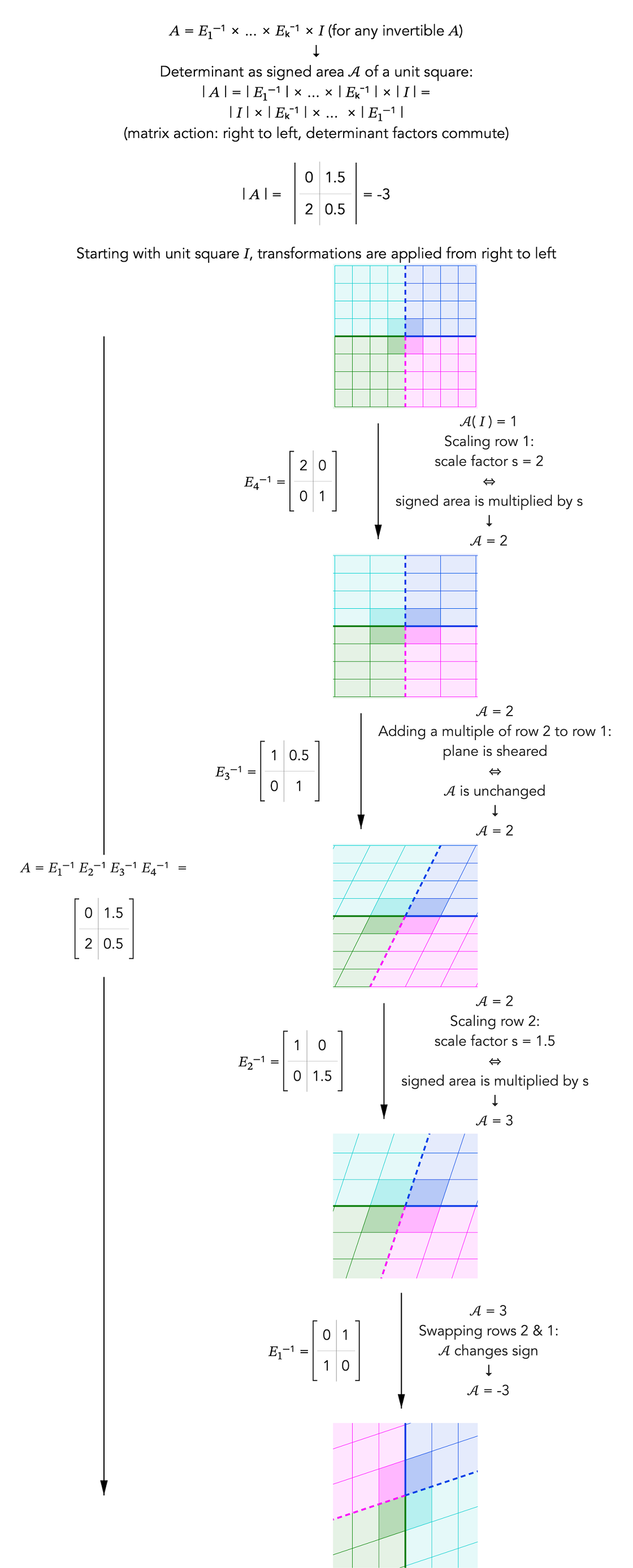
The chapter ends by reinterpreting determinant computation as building the target shape from the unit square or cube while tracking signed area or volume at each step.
Why is determinant naturally connected to row reduction?
Because row operations change determinant in simple, controlled ways. Once a matrix is reduced to a triangular form, determinant can be read from the diagonal while correcting for swaps and scalings used along the way.
Related chapters
Related visual
Determinant from elementary matrices
Elementary-matrix product A = E₁⁻¹ × ... × Eₖ⁻¹ × I, shown as signed area in 2D and signed volume in 3D
Chapter contents
The PDF is a single document. The page links below are best-effort: most browsers support them, but some viewers may ignore the page hint.
Why does the geometric picture match the row-operation definition?
Row replacement shears the unit square or cube without changing signed area or volume. Row scaling multiplies signed area or volume by the scale factor. Row swapping reverses orientation, so the determinant changes sign. These are exactly the algebraic rules used to define determinant.