3×3 expansion by permutations and cofactors
The 3×3 case has six permutation terms. The diagram shows the selected entries, signs and submatrices that connect the permutation formula with cofactor expansion.
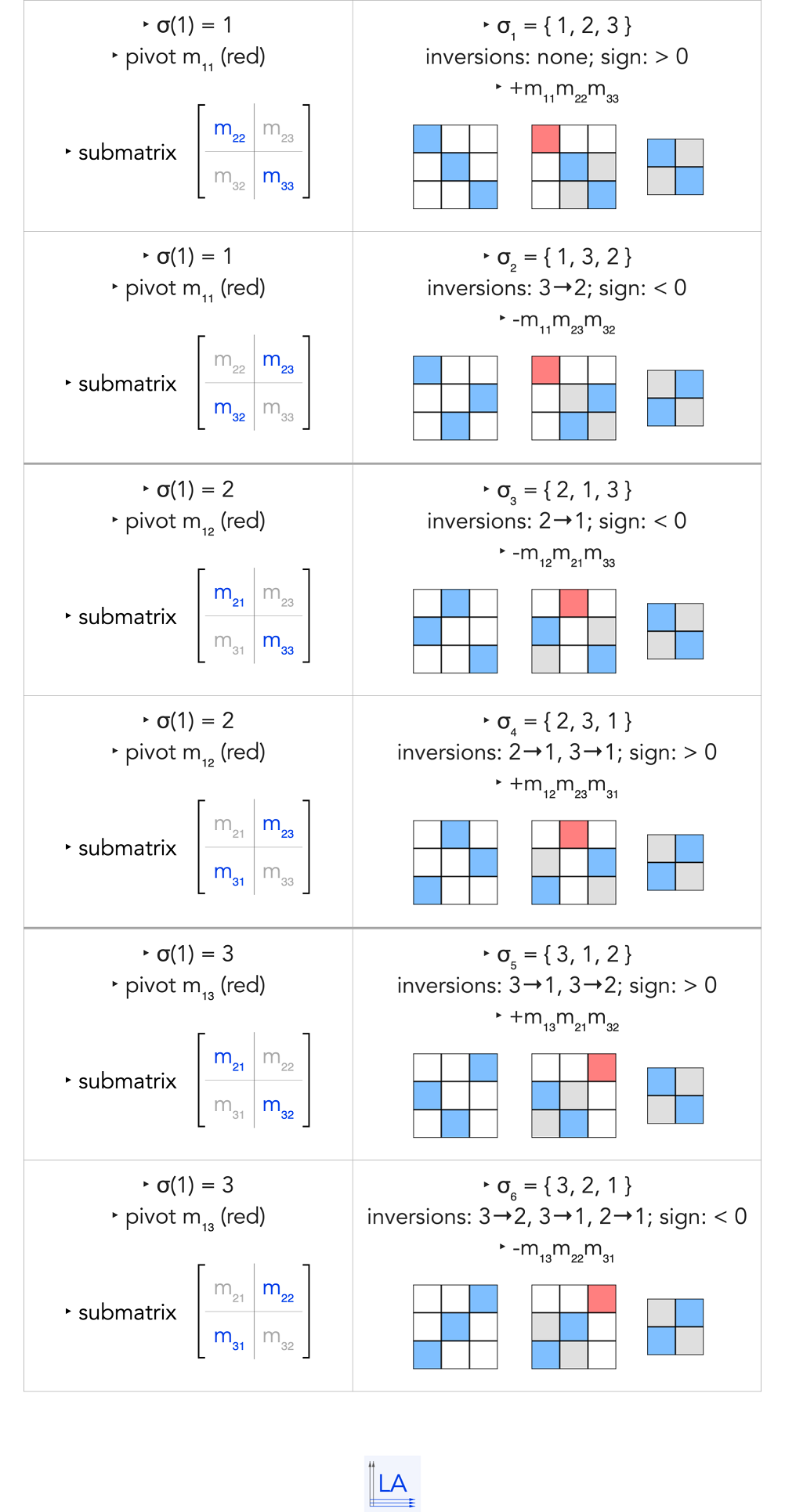
The determinant can be calculated as a signed sum over permutations. The same signed products can also be grouped through cofactor expansion, where each pivot is paired with the determinant of a remaining submatrix.
The previews below show only the top portion of the full diagrams. Click either preview to open the full-size image.
The 3×3 case has six permutation terms. The diagram shows the selected entries, signs and submatrices that connect the permutation formula with cofactor expansion.
The 4×4 case has twenty-four permutation terms. The full diagram is much taller, so the preview is cropped while the linked image opens the complete expansion.

A permutation term chooses one entry from each row and one entry from each column. Even permutations contribute with positive sign, while odd permutations contribute with negative sign.
Cofactor expansion organizes the same determinant calculation by fixing a pivot, deleting its row and column and computing the determinant of the remaining submatrix. The diagrams show how these viewpoints are connected.
In the 3×3 case, the six terms can still be read directly. In the 4×4 case, the expansion grows to twenty-four terms, so the grouping by pivots, submatrices and signs becomes more useful.
The visual purpose is to connect the compact determinant formulas with the actual signed products that appear in determinant calculation.
Related visual: Determinant visualization
Related visual: Determinant from elementary matrices
Related chapter: Determinant formulas: permutations and cofactors
Related work: GraphMath Linear Algebra
Contact: info@graphmath.com