QRF, Gram-Schmidt, part 3
What do we learn by watching orthogonalization happen step by step?
This chapter shows Gram-Schmidt orthogonalization as a sequence of geometric updates rather than only as symbolic formulas. It tracks how the columns are orthogonalized in 2×2 and 3×3 cases, shows how R accumulates the inverse right-side updates and explains the role of shear and scaling matrices in building Q and R.
Key ideas
Gram-Schmidt can be understood as a sequence of localized geometric updates that change one column at a time.
- Each subsequent matrix is obtained by right-multiplication Aₖ₊₁ = Aₖ Sₖ Dₖ, so one active column is changed at each step
- The shear matrices remove overlap with earlier orthogonal directions, while the diagonal matrices normalize the remaining column
- Q is produced by gradually removing scale and shear from A
- R accumulates the removed scale and shear through the inverse right-side updates
- The upper-triangular shape of R follows from the upper-triangular shape of every Sₖ, Dₖ and their inverses
This stepwise viewpoint makes QR factorization look like a sequence of transformations rather than a single final identity.
Why is gradual orthogonalization worth visualizing?
Because the usual symbolic formulas hide the fact that Gram-Schmidt changes one column at a time through specific geometric operations. The stepwise view shows exactly what is being removed, what is being normalized and how those updates accumulate into Q and R.
Related chapters
Examples with visualizations
3×3 Gram-Schmidt QR worked example
Column-by-column construction of Q and R with geometric views
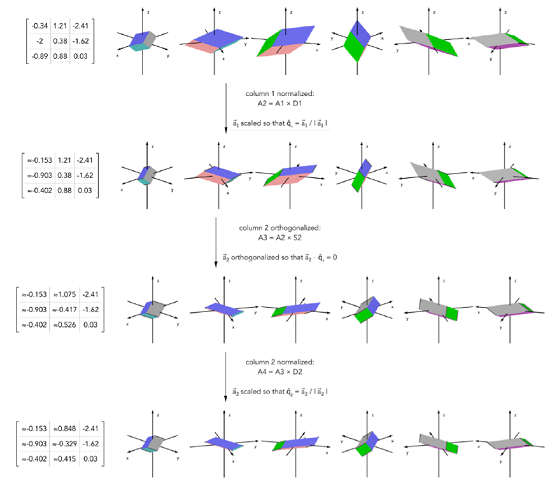
Gram-Schmidt orthogonalization — stepwise visualization
Stepwise correction and normalization of columns in 2D and 3D
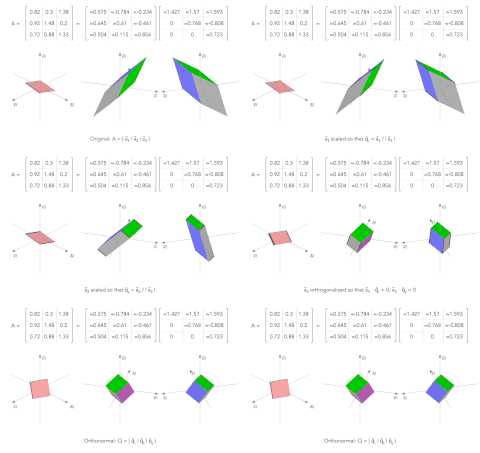
Three geometric routes to QR
Gram-Schmidt, Givens rotations and Householder reflections compared on the same matrices
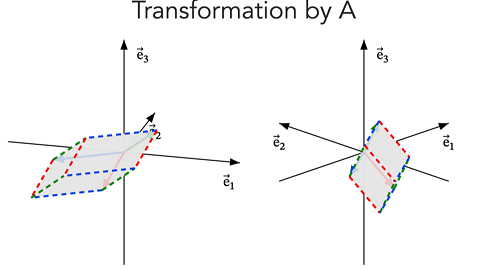
Chapter contents
The chapter is available as a PDF. Page links below are best-effort: most browsers support them but some viewers may ignore the page hint.
Why does right-multiplication appear in this construction?
Because Gram-Schmidt changes columns, and right-multiplication is the natural way to update columns one at a time. Each shear or scaling matrix differs from the identity in one active column, so the sequence Aₖ₊₁ = Aₖ Sₖ Dₖ tracks the orthogonalization column by column.