QRF, Gram-Schmidt, part 1
What does the Q part of QR factorization represent?
Gram-Schmidt builds orthogonal directions one by one, then normalizes them to create Q. This chapter develops that process, shows why Q preserves lengths and angles, explains the determinant and geometric meaning of square Q, extends the picture to tall Q and derives QQᵀ as the orthogonal projection onto col(Q).
Key ideas
Gram-Schmidt removes components along earlier directions so that each new vector contributes only its genuinely new direction. Normalizing those directions produces the columns of Q.
- The columns of Q are orthonormal, so QᵀQ = I and multiplication by Q preserves lengths and angles
- For square Q, determinant is ±1, matching the geometric role of rotation or reflection
- For tall Q, multiplication is an isometric embedding from a lower-dimensional space into a higher-dimensional one
- Left-multiplication by Qᵀ reverses that embedding on the image, while QQᵀ projects onto the embedded subspace
- When the columns are orthonormal, QQᵀ can be written as a sum of outer products and acts as orthogonal projection onto col(Q)
Part 2 then turns from Q to R and shows how QR factorization separates deformation from rotation or reflection.
Why is Q geometrically special?
Because Q preserves lengths and angles. In the square case it acts as a rigid motion, and in the tall case it embeds the domain into a higher-dimensional space without distortion.
Related chapters
Examples with visualizations
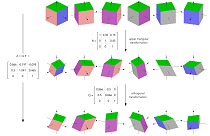
QR decomposition — geometric interpretation
Upper-triangular deformation followed by an orthogonal transformation in 2D and 3D
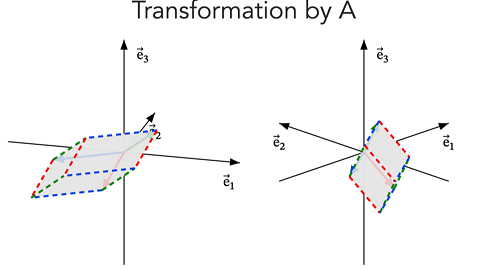
Three geometric routes to QR
Gram-Schmidt, Givens rotations and Householder reflections compared on the same matrices
Chapter contents
The chapter is available as a PDF. Page links below are best-effort: most browsers support them but some viewers may ignore the page hint.
| Topic | Pages |
|---|---|
| Gram-Schmidt orthogonalization | 1–2 |
| Structure of matrix Q | 3–4 |
| Properties of Q defined as QᵀQ = I | 4–5 |
| Determinant of square Q | 5–6 |
| Combined rotation and reflection | 6–8 |
| Transformation by a 'tall' Q (m>n) | 8–10 |
| Matrix Q Qᵀ | 10–11 |
| Q Qᵀ as sum of outer products | 11–13 |
Why does Q Qᵀ become a projection matrix?
Because when the columns of Q are orthonormal, QᵀQ = I and the general projection formula simplifies to Q(QᵀQ)⁻¹Qᵀ = QQᵀ. This makes QQᵀ the orthogonal projection onto the space spanned by the columns of Q.