QRF, Gram-Schmidt, part 2
What does the R part of QR factorization represent?
This chapter develops the structure of matrix R, shows why upper-triangular form appears in QR factorization and explains how QR separates deformation from rotation or reflection. It then presents geometric views of the factorization in square and tall cases, interprets the hierarchy encoded by R and ends with a demonstration of the rank-deficient case.
Key ideas
After Gram-Schmidt produces Q, the matrix R records how the original columns are assembled from the orthonormal directions. Its upper-triangular form reveals both algebraic dependence and geometric order.
- R = QᵀA, and zeros below the diagonal appear because each new orthogonal direction is orthogonal to the earlier columns
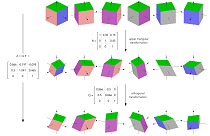
- In A = QR, R gives hierarchical deformation while Q provides rotation or reflection
- The same factorization can also be read as a basis interpretation: Q defines a new orthonormal basis and R gives coordinates in that basis
- The hierarchy of R explains both forward transformation of space and backward solution of triangular systems
Together with part 1, this chapter completes the structural and geometric picture of QR factorization.
Why is R upper triangular?
Because each orthogonal direction is built from the current column after removing components along earlier directions. That makes later basis vectors orthogonal to earlier columns, which creates zeros below the diagonal in QᵀA = R.
Related chapters
Examples with visualizations
QR decomposition — geometric interpretation
Upper-triangular deformation followed by an orthogonal transformation in 2D and 3D
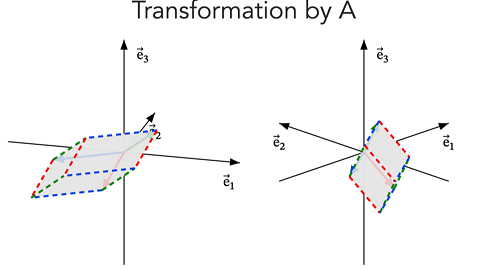
Three geometric routes to QR
Gram-Schmidt, Givens rotations and Householder reflections compared on the same matrices
Chapter contents
The chapter is available as a PDF. Page links below are best-effort: most browsers support them but some viewers may ignore the page hint.
What is the geometric meaning of R?
Since R = QᵀA, R is A after an orthogonal transformation. Geometrically, the columns of A have been rotated or reflected into the upper-triangular arrangement recorded by R. No projection is involved and no information is lost.