Determinant visualization
How can determinant sign and cofactor signs be read visually?
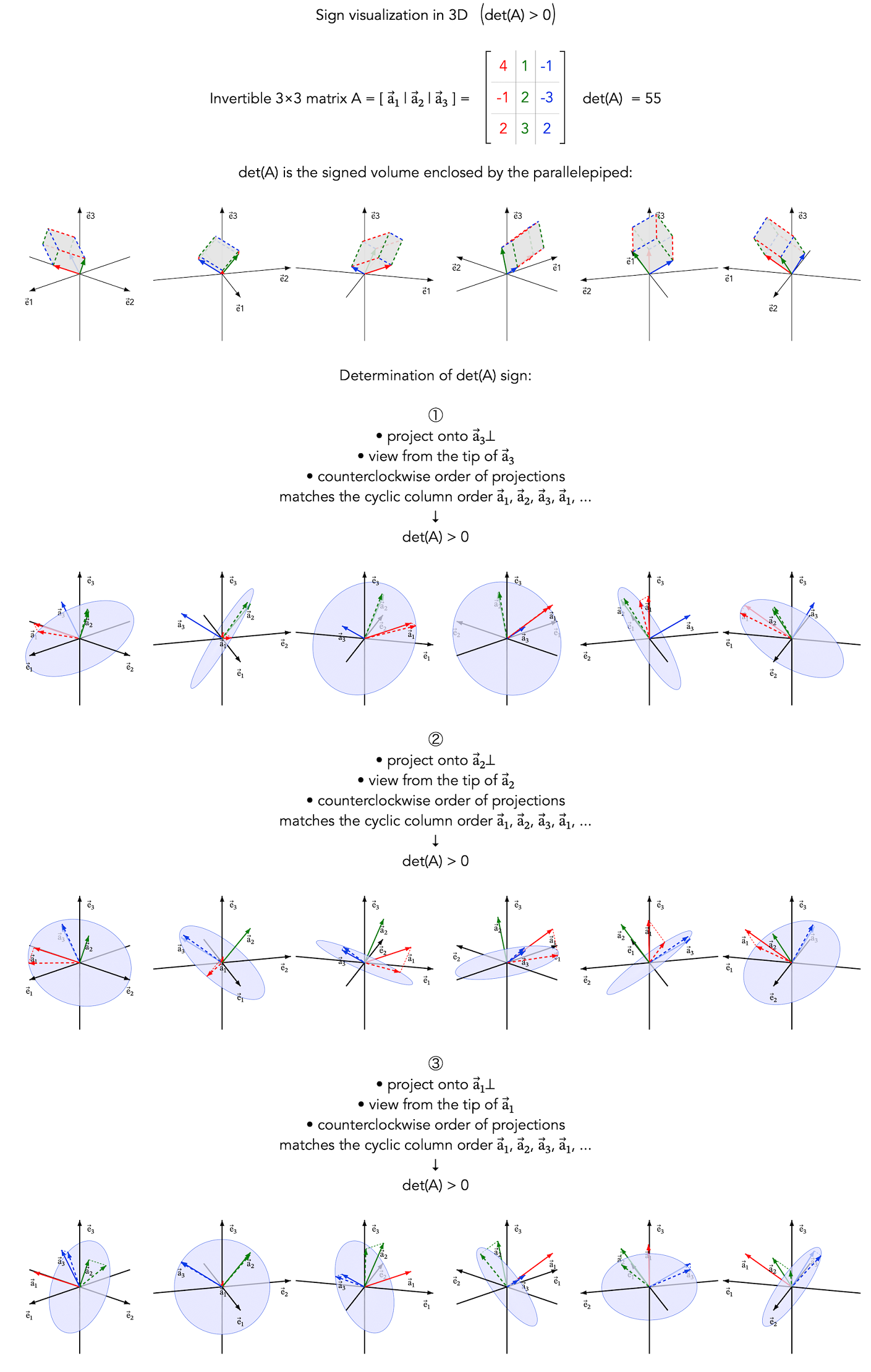
The determinant of a 3×3 matrix is signed volume. This chapter shows how to read its sign by choosing one column as the viewing vector, projecting the other two columns onto the orthogonal plane and comparing the visible counterclockwise order with the cyclic column order. The same orientation idea then leads to a higher-dimensional recursive projection rule and to a visual explanation of cofactor signs in ℝ³ and ℝ⁴.
Key ideas
Determinant sign is orientation, not just a plus or minus attached to volume.
- In ℝ³, choose one column vector as the viewing vector and project the other two column vectors onto its orthogonal plane
- Looking from the tip of the viewing vector toward the origin converts the sign problem into a 2D orientation problem
- If the projected arrows appear in cyclic column order, then det(A) > 0
- If the projected arrows appear in the reversed order, then det(A) < 0
- If the projected arrows are linearly dependent, then no counterclockwise order is defined and det(A) = 0
- Cofactor signs follow from how many swaps are needed to restore the standard row-direction order
The later pages extend this orientation rule beyond 3D and connect it to the alternating signs in cofactor expansion.
Why does projection reveal the sign?
Projecting onto the plane perpendicular to one column removes the viewing direction but keeps the orientation information needed to decide sign. From the tip of the viewing vector, the remaining two projected arrows either match the cyclic column order or reverse it.
Related chapters
Related visual
Determinant sign visualization
Projected cyclic order, orientation and cofactor signs
Chapter contents
The PDF is a single document. The page links below are best-effort: most browsers support them, but some viewers may ignore the page hint.
How do cofactor signs fit this orientation picture?
In expansion along column 1, term i starts with the pivot row direction followed by the row directions of the minor. Restoring the standard order requires i−1 swaps, so even numbers of swaps keep the sign and odd numbers of swaps negate it.