Determinant visualization — Orientation and projected cyclic order
The determinant of a 3 × 3 matrix is the signed volume of the parallelepiped formed by its columns. Its absolute value measures volume, while its sign records orientation.
These diagrams show a way to read the sign by projecting two column vectors onto a plane perpendicular to the third column, then comparing the visible counterclockwise order with the cyclic column order.
Positive and negative determinant sign
The two sign diagrams use the same visual test for matrices with opposite determinant sign. Click either image to open the full-size version.
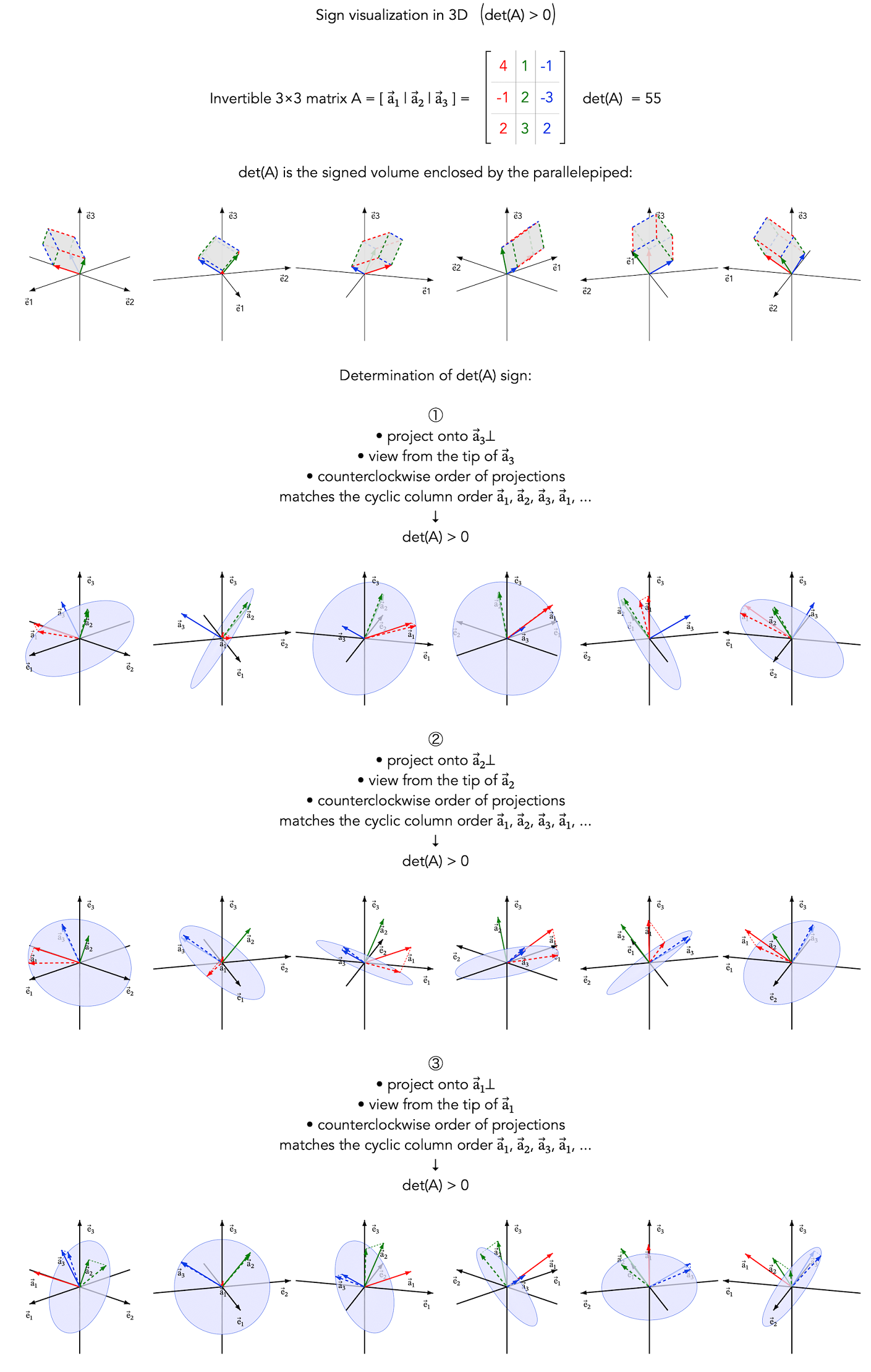
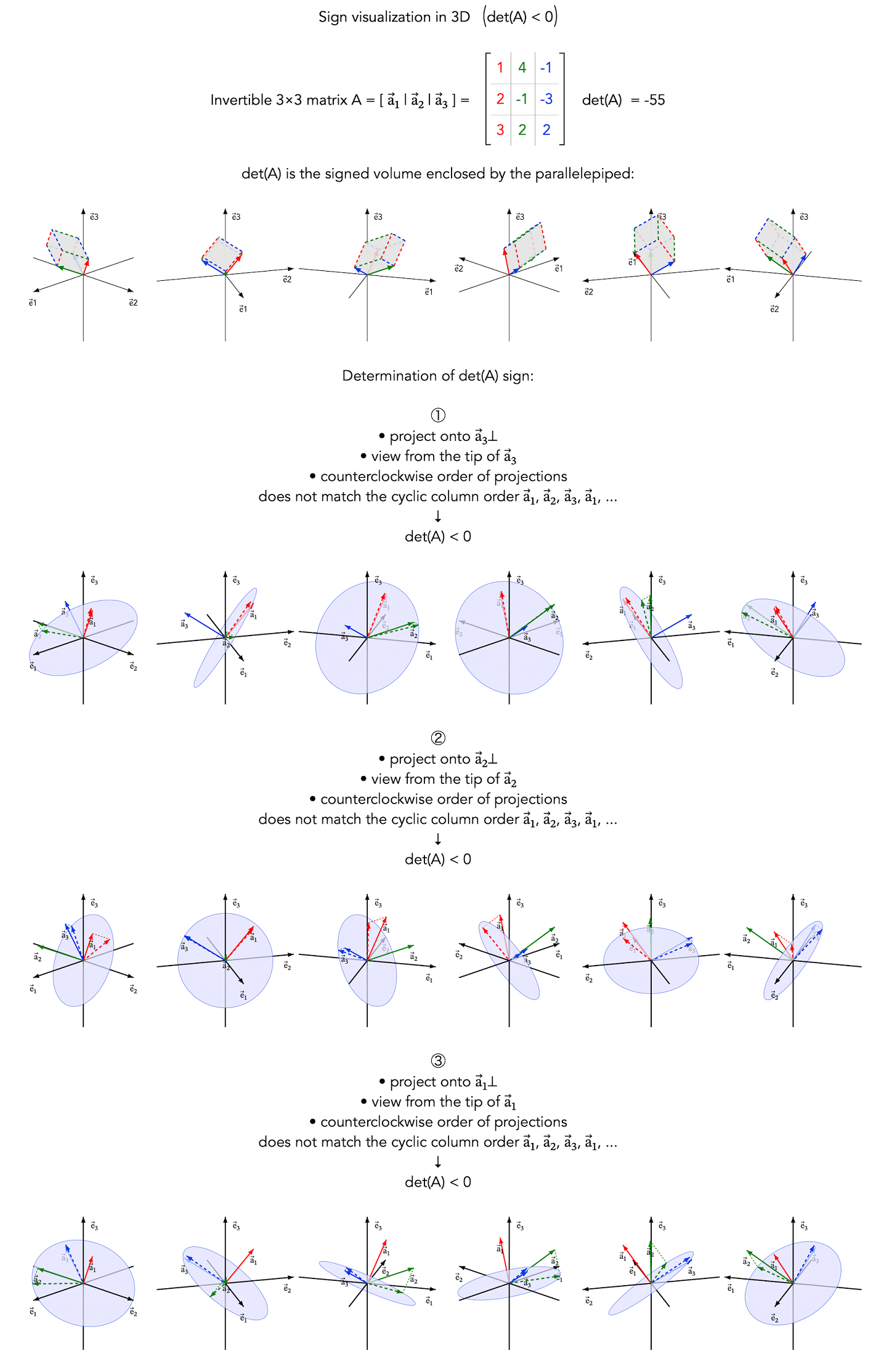
How to read the sign visually
Choose one column vector as the viewing vector. Project the two remaining column vectors onto the plane orthogonal to it, then look from the tip of the viewing vector toward the origin.
- Method 1: project a₁ and a₂ onto the plane perpendicular to a₃
- Method 2: project a₃ and a₁ onto the plane perpendicular to a₂
- Method 3: project a₂ and a₃ onto the plane perpendicular to a₁
If the projected arrows appear in the cyclic column order a₁, a₂, a₃, a₁, … then det(A) > 0. If the visible order is reversed, then det(A) < 0. If the projected arrows are linearly dependent, then det(A) = 0.
Why the three projection methods agree
In 3D, cyclic column shifts preserve determinant sign because three is odd. For example, replacing the column order by [a₃ | a₁ | a₂] or [a₂ | a₃ | a₁] is a cyclic shift and can be obtained by two column exchanges, so the determinant sign is unchanged.
Applying the first projection method after such a cyclic relabeling becomes identical to applying the second or third method to the original matrix. This is why all three projected-order tests give the same sign.
Cofactor expansion visualization
The cofactor diagram shows how expansion along one column can be interpreted through one projected column component and one projected minor for each term. Click the image to open the full-size version.
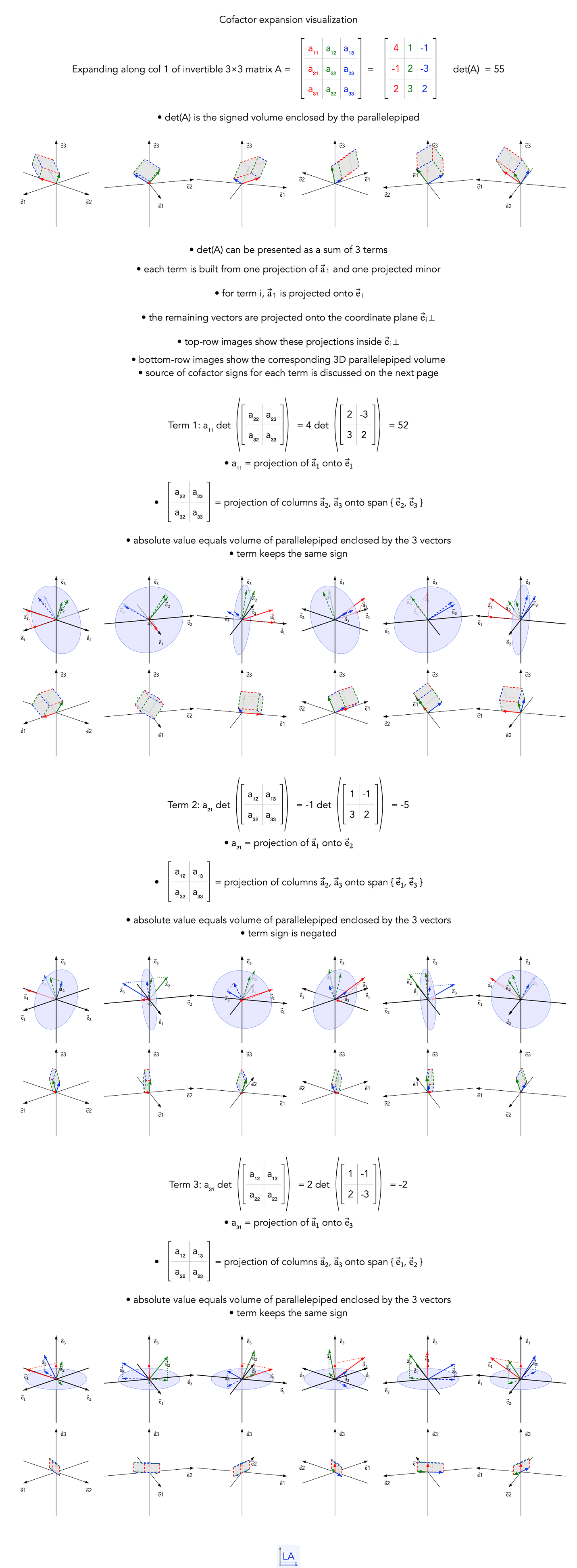
More details
For more details, see the Determinant visualization chapter PDF.
Concept
Determinant sign is an orientation test. In 3D, one can reduce the sign question to a 2D orientation problem in a projection plane.
The projected arrows are compared with the cyclic column order. Matching order gives a positive determinant, reversed order gives a negative determinant and linear dependence gives determinant zero.
Key equations
Query phrases
- determinant sign visualization in 3D
- determinant sign as orientation
- determinant projected cyclic order
- visualizing positive and negative determinant in 3D
- cofactor expansion visualization
References
Related concept: Determinant formulas: permutations and cofactors
Related concept: Determinant from elementary matrices
Related chapter: Determinant visualization