Determinant formulas: permutations and cofactors
The determinant can be expanded as a signed sum over permutations, and the same terms can also be organized by cofactor expansion. Each permutation contributes one signed product, while cofactor expansion groups those products by a chosen pivot and its remaining submatrix.
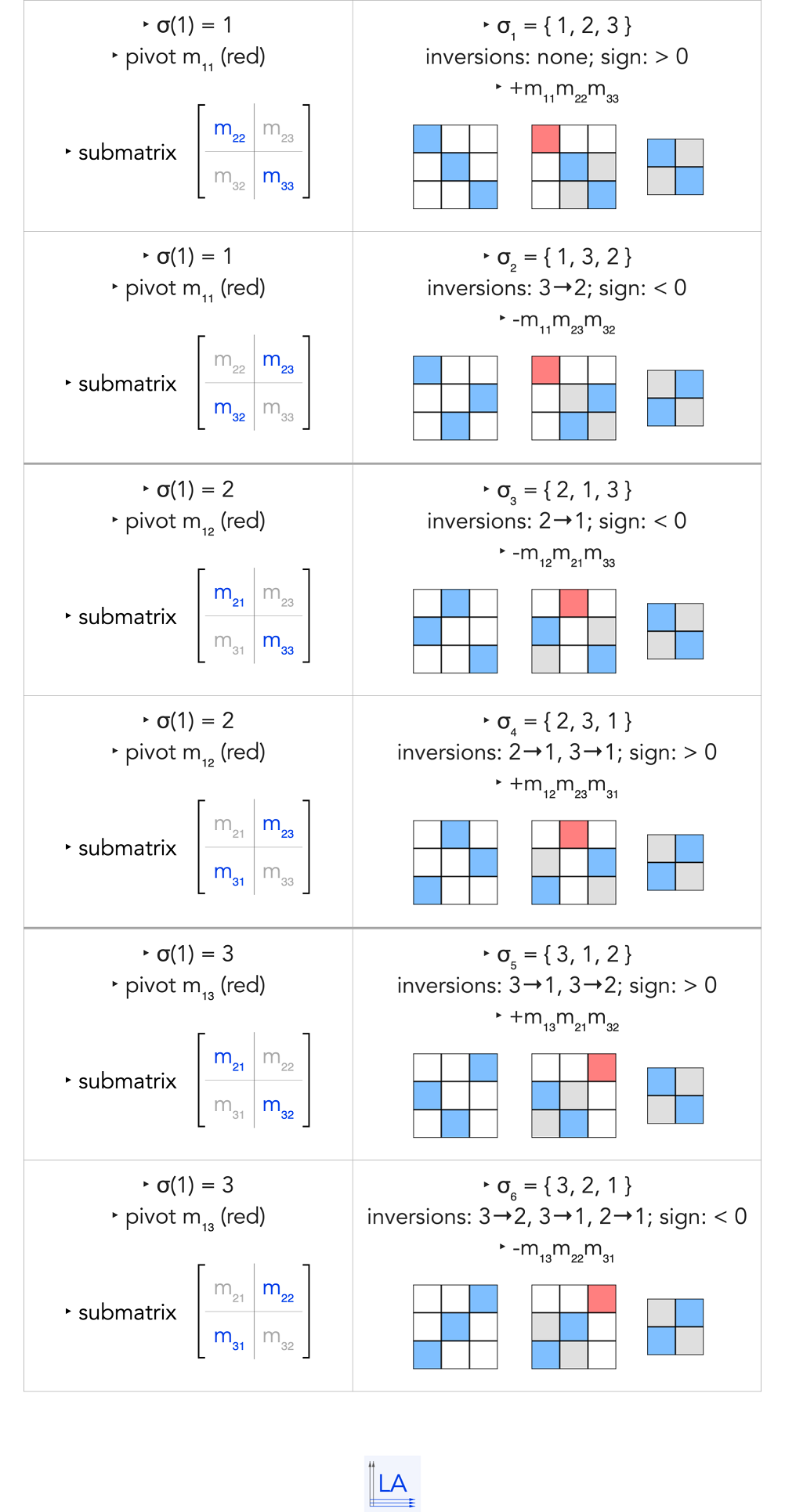
This visualization makes the selected entries, submatrices, permutation signs and cofactor grouping visible in the 3×3 and 4×4 cases.
3×3 expansion by permutations and cofactors
In the 3×3 case, there are six permutation terms. The diagram shows the selected entries, their signs and the submatrices that appear when the same calculation is read as cofactor expansion.
4×4 expansion by permutations and cofactors
In the 4×4 case, the permutation formula produces twenty-four terms. The larger diagram shows how those signed products can be grouped through cofactor expansion into smaller determinant calculations.

Concept
For an n × n matrix, a permutation chooses one column index for each row. The condition that the chosen column indices form a permutation guarantees that no column is reused.
Cofactor expansion reorganizes the same determinant by fixing a pivot entry, deleting its row and column, and taking the determinant of the remaining submatrix. The cofactor sign supplies the alternating sign attached to that grouped set of permutation terms.
Key equations
The permutation formula lists all signed products directly. Cofactor expansion groups the same determinant terms through pivots and submatrices.
Query phrases
- determinant expansion visualization
- determinant permutation expansion visualization
- cofactor expansion visualization
- determinant by permutations and cofactors
- determinant calculation visualization
- Leibniz formula determinant visualization
- 3 by 3 determinant permutation cofactor expansion
- 4 by 4 determinant permutation cofactor expansion
References
Related concept: Determinant visualization
Related concept: Determinant from elementary matrices
Related chapter: Determinant formulas: permutations and cofactors