Positive determinant sign in 3D
The projected arrows appear in the cyclic column order, so det(A) > 0. Click the image to open the full-size version.
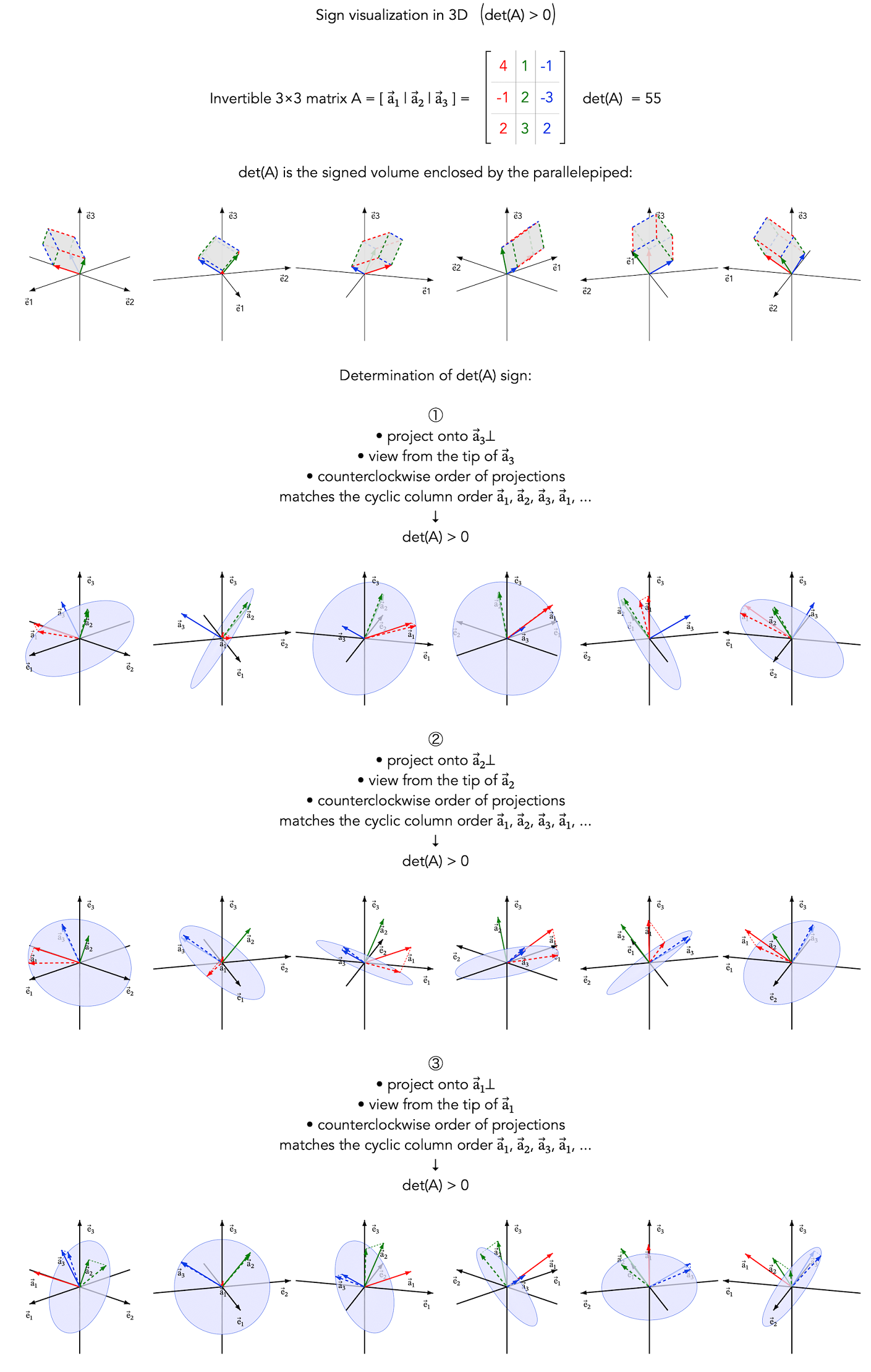
The determinant of a 3 × 3 matrix is the signed volume of the parallelepiped formed by its columns. These visuals show how the sign can be read from orientation, projected cyclic order and cofactor expansion.
The projected arrows appear in the cyclic column order, so det(A) > 0. Click the image to open the full-size version.
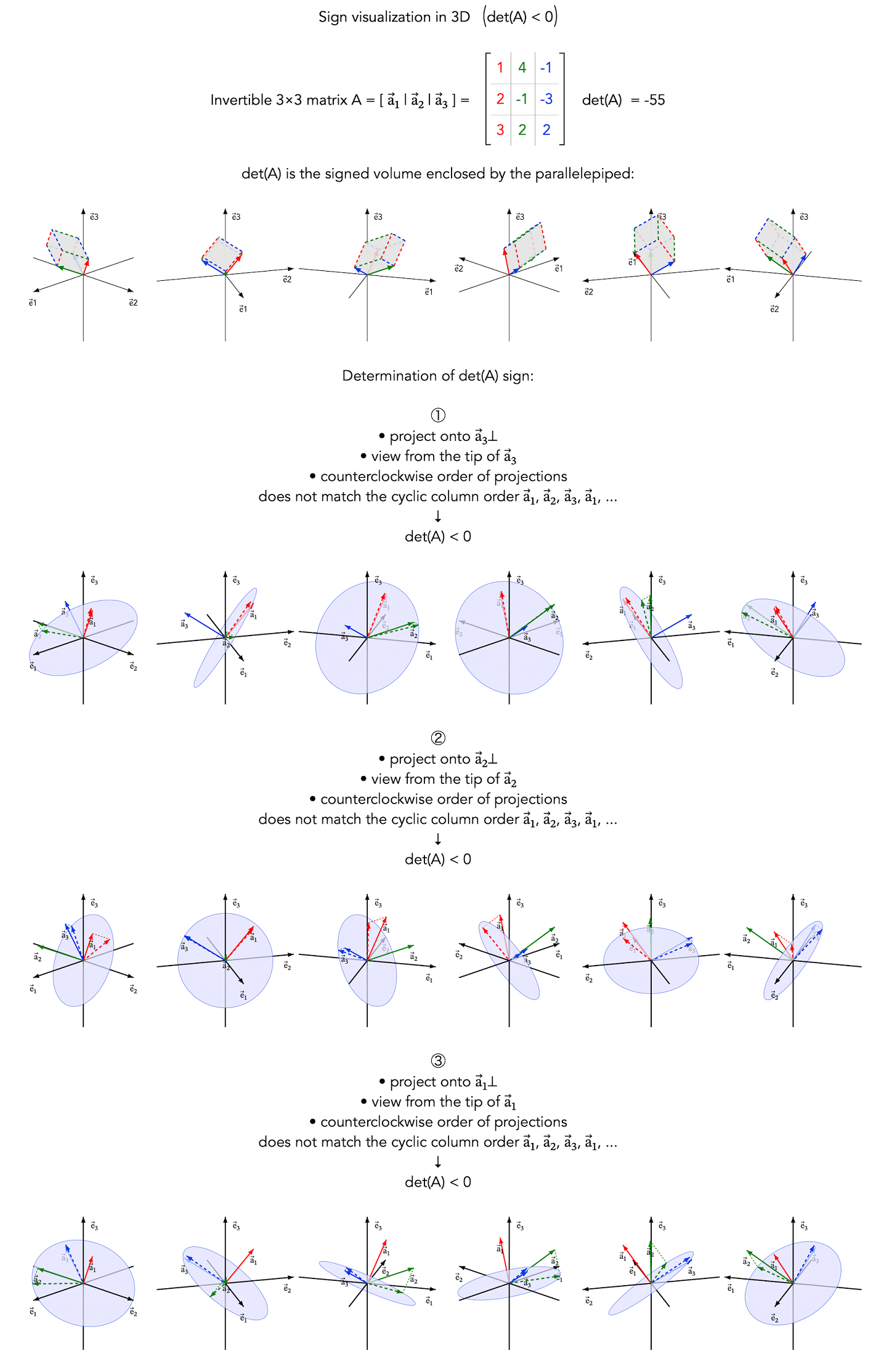
The visible projected order is reversed relative to the cyclic column order, so det(A) < 0. Click the image to open the full-size version.
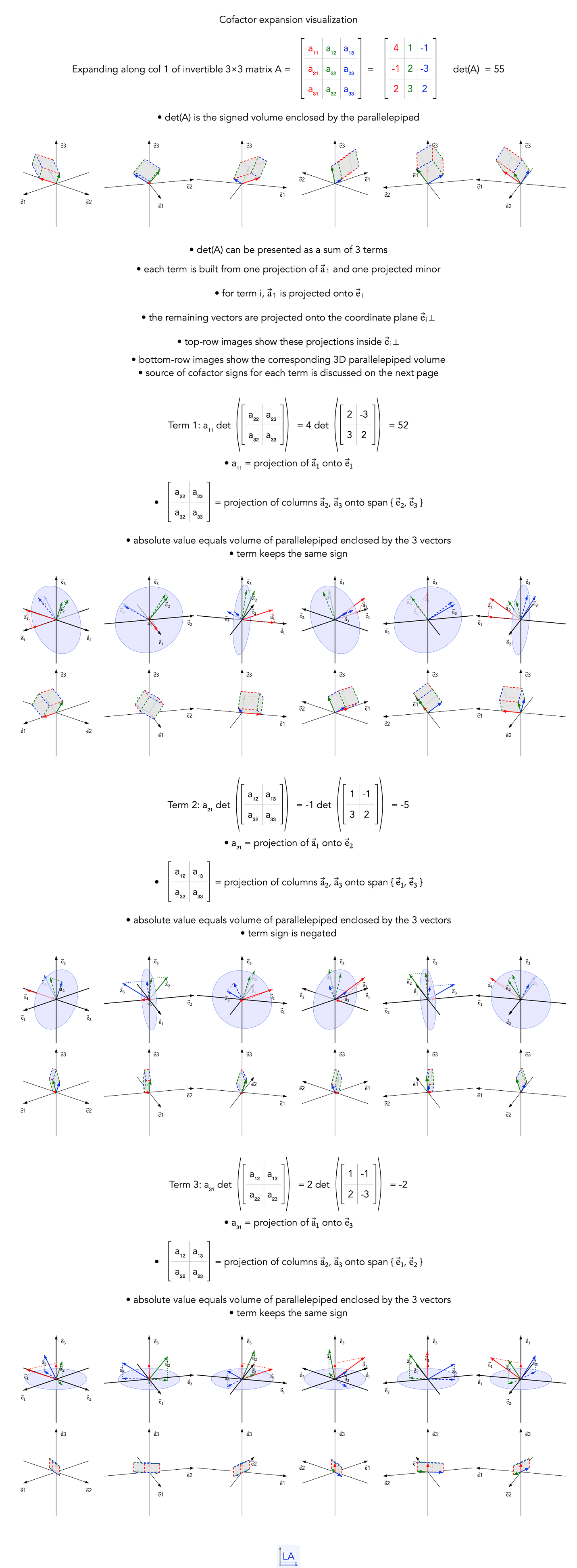
This diagram interprets cofactor expansion as a sum of signed projected-volume terms. Click the image to open the full-size version.
Choose one column vector as the viewing vector. Project the two remaining column vectors onto the plane orthogonal to it, then look from the tip of the viewing vector toward the origin.
If the projected arrows appear in the cyclic column order a₁, a₂, a₃, a₁, … then det(A) > 0. If the visible order is reversed, then det(A) < 0. If the projected arrows are linearly dependent, then det(A) = 0.
The three methods agree because cyclic column shifts preserve determinant sign in three dimensions. Changing from [a₁ | a₂ | a₃] to [a₃ | a₁ | a₂] or [a₂ | a₃ | a₁] takes two column exchanges, so the determinant sign is unchanged.
After such a cyclic relabeling, applying the first projection method becomes identical to applying the second or third method to the original matrix.
Cofactor expansion splits the determinant into signed terms. In the visual interpretation, each term combines one projected column component with the signed area of a projected minor.
For more details, see the Determinant visualization chapter PDF.
Related visual: Determinant from elementary matrices
Related chapter: Determinant visualization
Related work: GraphMath Linear Algebra
Contact: info@graphmath.com