Why Cramer’s Rule Works: Geometric Derivation in R², R³ and Rⁿ
Cramer's rule expresses each solution coordinate of A x = b as a determinant ratio. The formula is often presented as a computation rule, but it has a direct geometric reason.
In R², the determinant is signed area, so the same determinant ratio can be read as a ratio of signed areas with a common base and corresponding heights. In R³, replacing one column of A by b changes a signed volume by exactly the coordinate factor being isolated. In Rⁿ, the same idea follows from determinant multilinearity and from the fact that a determinant vanishes when two columns become linearly dependent.
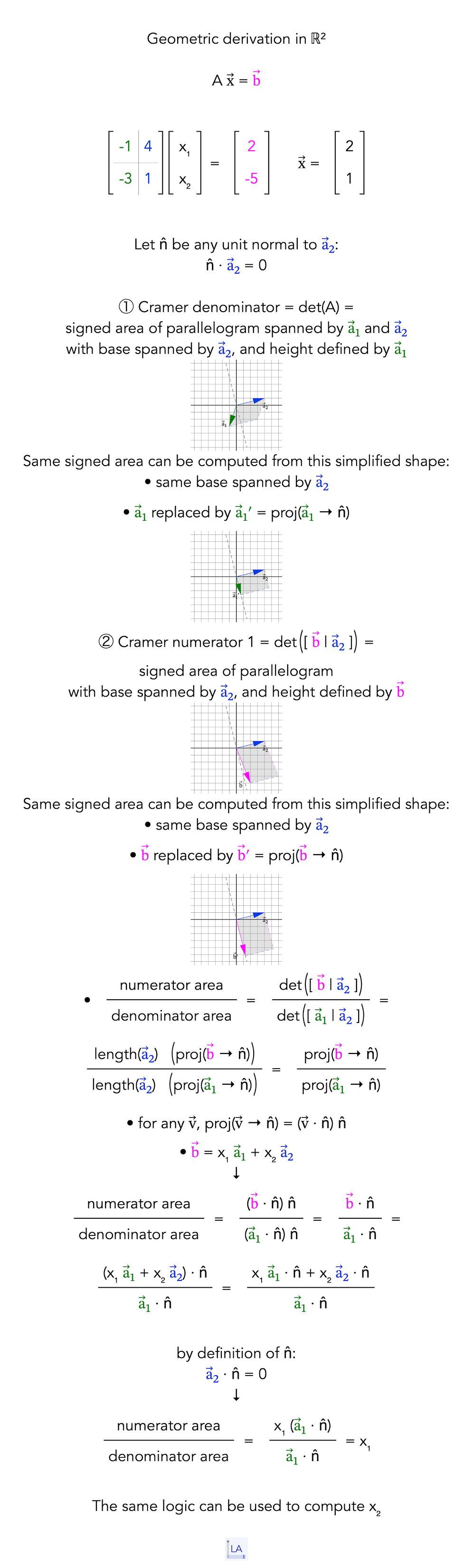
Geometric derivation in R²
In two dimensions, the determinant is signed area. The ratio in Cramer's rule can be seen as a ratio of signed areas with the same base direction and with heights measured along a normal direction. Click the image to open the full-size version.
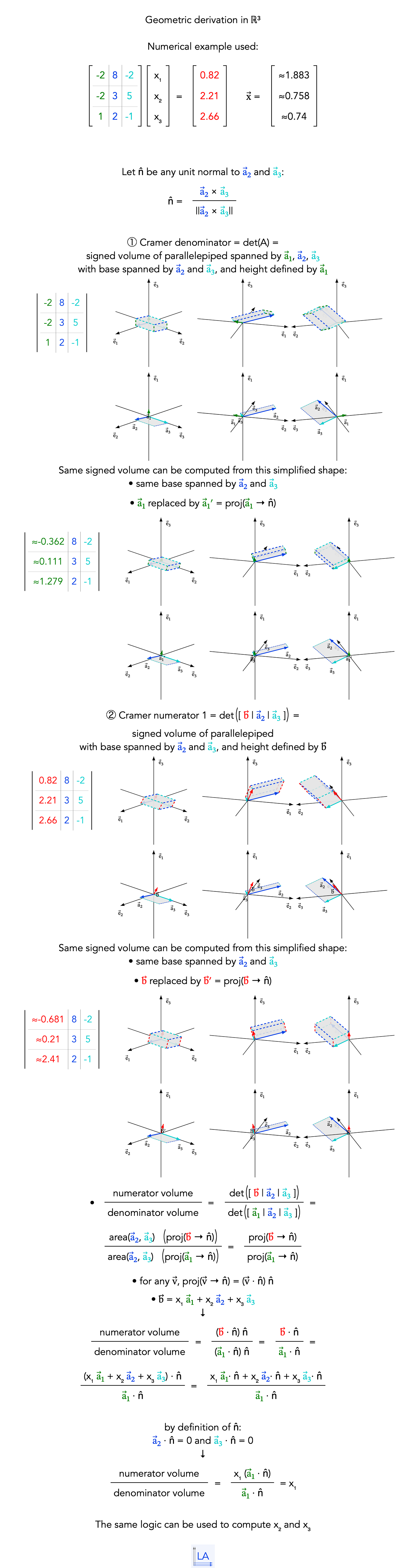
Geometric derivation in R³
The 3D picture emphasizes signed volume. Replacing one column by b isolates one coordinate because the volume scales by that coordinate while the remaining column directions stay fixed. Click the image to open the full-size version.
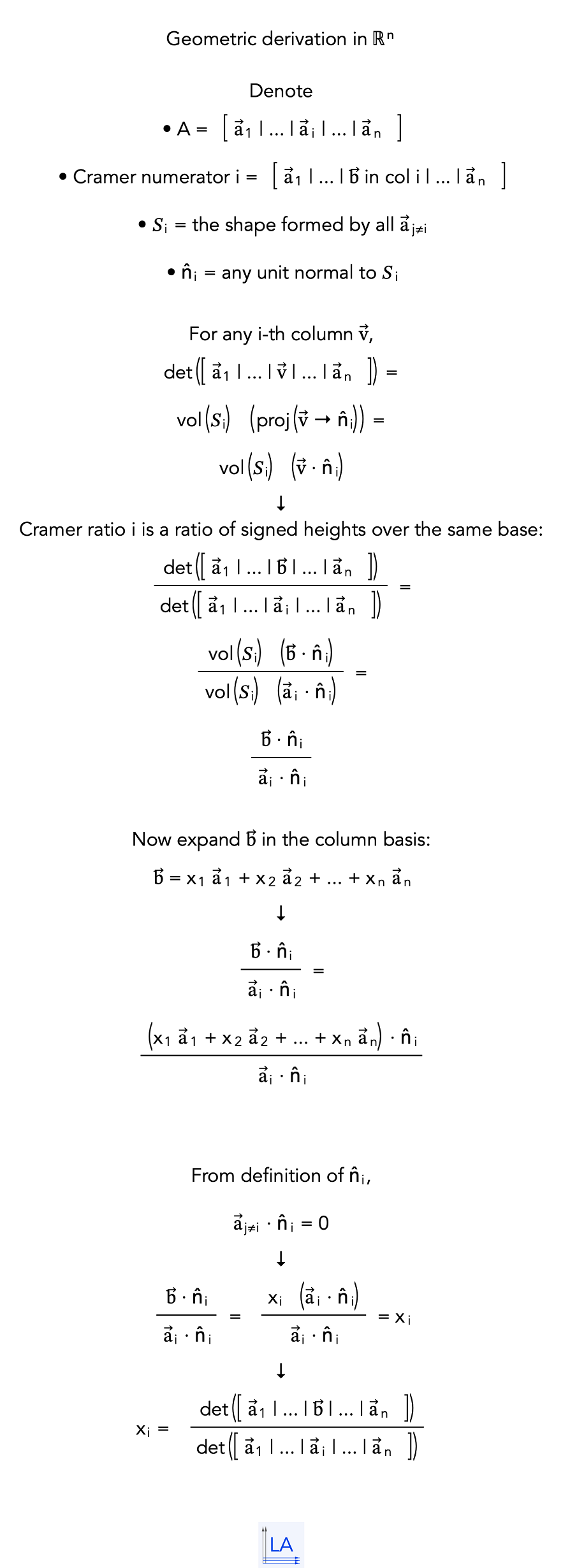
Geometric derivation in Rⁿ
The same argument works in any dimension. Expanding b in the column basis of A and using multilinearity of the determinant leaves only the term where b replaces the selected column. Click the image to open the full-size version.
Concept
Suppose A = [a₁ | a₂ | ... | aₙ] is square and full rank, and A x = b. Then b = x₁a₁ + x₂a₂ + ... + xₙaₙ.
Let Ak be the matrix obtained from A by replacing column k with b. When b is expanded inside the determinant, every term has two proportional columns except the term containing xkak. Therefore det(Ak) = xk det(A).
Key equations
These equations show why column replacement isolates one solution coordinate at a time. In R² and R³, the same relation can be viewed as signed area or signed volume scaling.
Query phrases
- why Cramer's rule works geometric derivation
- Cramer's rule geometric derivation in R2 R3 and Rn
- Cramer's rule visualization signed area and signed volume
- determinant ratio derivation Cramer's rule
- why replacing one column gives one coordinate
- Cramer's rule determinant multilinearity
References
Related concept: GraphMath — Cramer's Rule, Determinant Ratios and 3D Geometry
Related chapter: GraphMath — Cramer's rule