Cramer's Rule — Determinant Ratios and 3D Geometry
Cramer's rule expresses each component of the solution to A x = b as a ratio of determinants. For a square full-rank matrix A, the solution is unique, and each coordinate xk can be recovered by replacing the k-th column of A with b.
Geometrically, the determinant measures signed volume. The numerator determinant records the signed volume after one column has been replaced by the target vector b, and the denominator determinant records the signed volume of the original column parallelepiped.
Cramer's rule in 3D
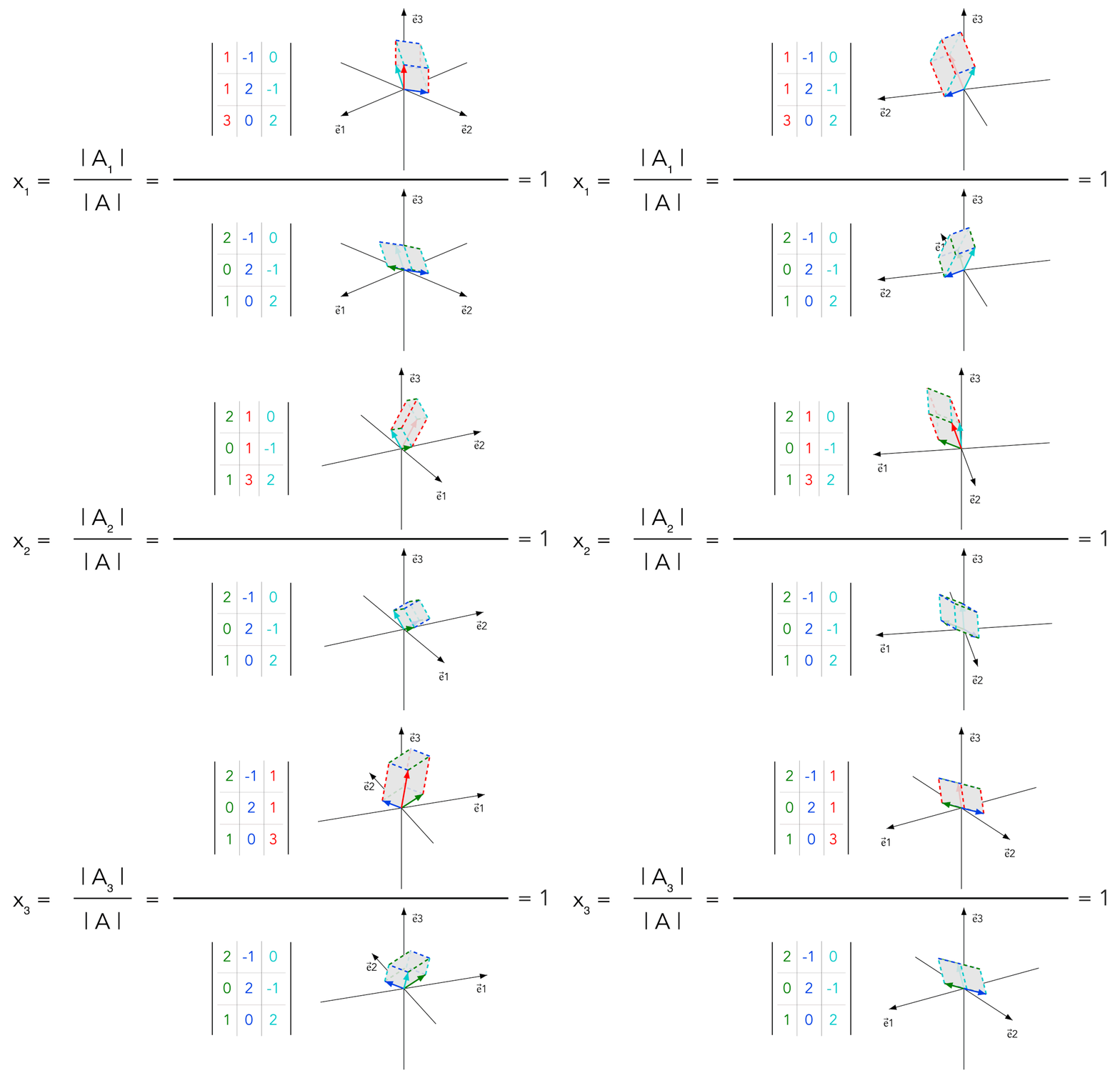
Concept
In a system A x = b, the columns of A form the directions used to build b as a linear combination. Cramer's rule isolates one coordinate at a time by replacing the corresponding column of A with b.
If Ak is the matrix obtained from A by replacing column k with b, then the ratio |Ak| / |A| gives the coordinate xk. The determinant product rule is what makes this isolation possible.
Structure
The denominator |A| measures the signed volume of the original parallelepiped formed by the columns of A. The numerator |Ak| measures the signed volume after one generating vector has been replaced by b.
Dividing these signed volumes extracts one solution coordinate. In 3D, the sign of that coordinate can be read from which side of the opposite face the replaced vector lies on, together with the orientation of the original column frame.
Key equations
These equations express each solution coordinate as a ratio of signed volumes.
Query phrases
- Cramer's rule determinant ratio geometric interpretation
- Cramer's rule in 3D signed volume
- why replacing one column gives one coordinate
- xk equals determinant ratio Cramer's rule meaning
- Cramer's rule visualization
Reference
Related concept: GraphMath — Why Cramer’s Rule Works: Geometric Derivation in R³ and Rⁿ
Related chapter: Cramer's rule