Column view
The column view shows how each elementary row operation acts on all columns together. As row reduction moves the matrix toward reduced echelon form, the columns move through the same left-multiplication steps.
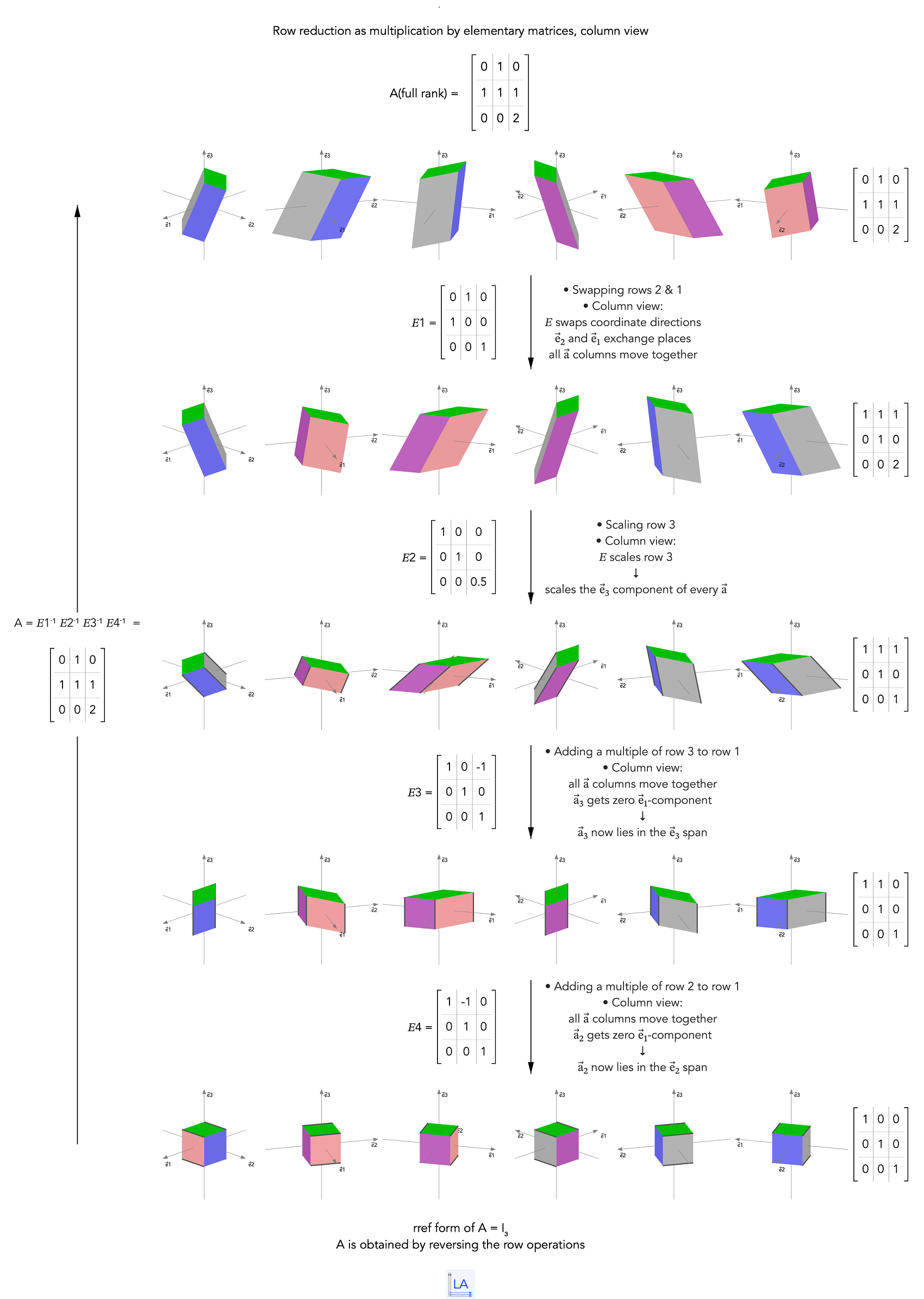
Row reduction can be written as multiplication by elementary matrices. The same algebraic steps can be viewed in different geometric ways: as motion of columns, or as changes in row normal planes and row vectors.
The previews below are reduced because the full diagrams are tall. Click either preview to open the full-size image.
The column view shows how each elementary row operation acts on all columns together. As row reduction moves the matrix toward reduced echelon form, the columns move through the same left-multiplication steps.
The row view shows the same row-reduction steps through row normal planes and row vectors. Row operations replace, scale or swap equations, so the row geometry changes step by step while the reduction proceeds.
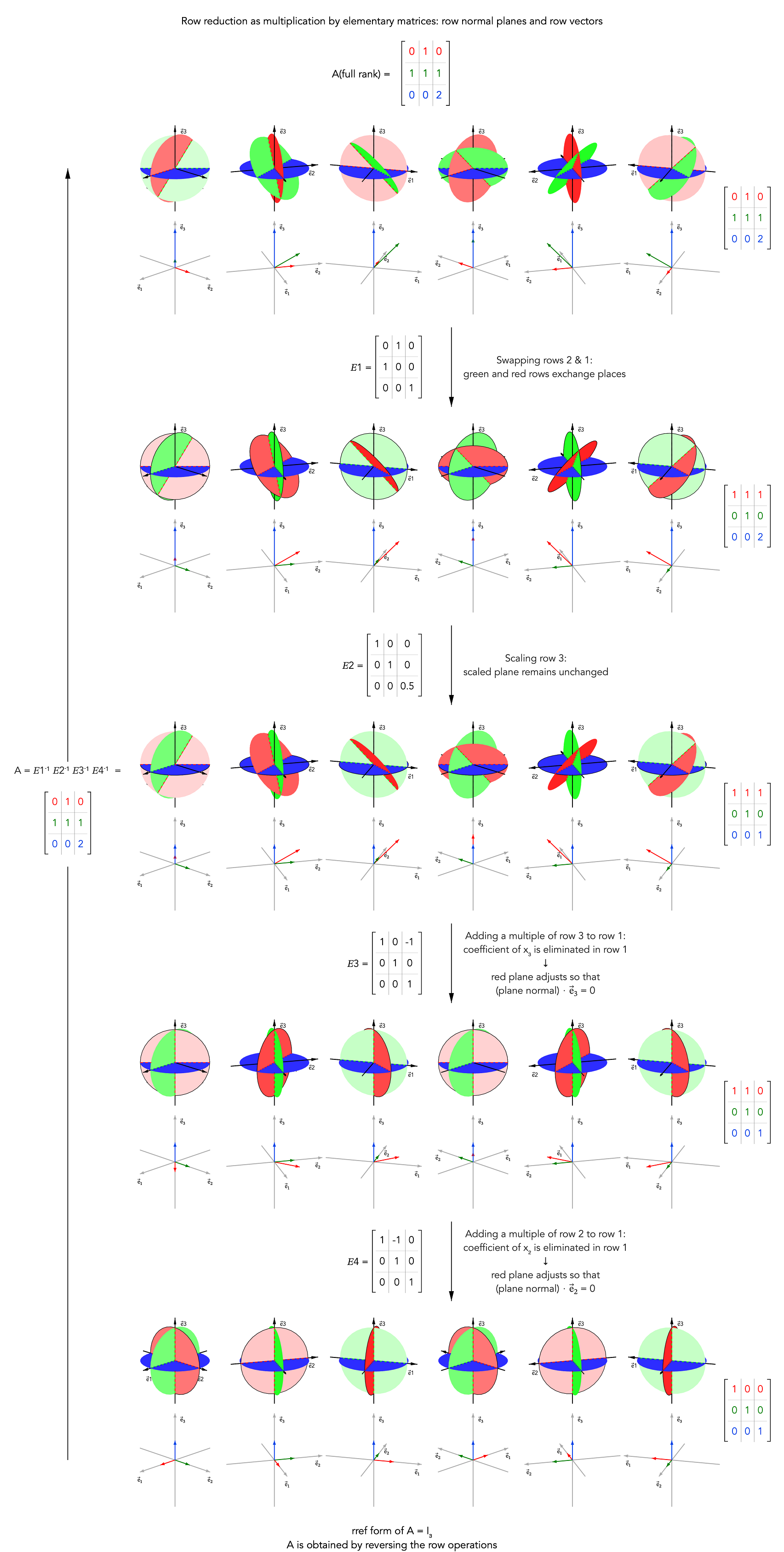
Each elementary row operation corresponds to multiplication on the left by an elementary matrix. A sequence of row operations therefore becomes a product of elementary matrices applied to the original matrix.
The column view emphasizes that left multiplication transforms every column at once. The row view emphasizes how the equations themselves change: row-normal planes and row vectors are updated by the elementary operations.
If row reduction transforms A into R, then R = Ek ··· E2E1A. Equivalently, A = E1−1E2−1 ··· Ek−1R.
In the full-rank square example shown here, the reduced row echelon form is the identity matrix, so the original matrix is rebuilt by reversing the row operations.
Related chapter: Row reduction
Related work: GraphMath Linear Algebra
Contact: info@graphmath.com