Householder Reflection — Geometric Interpretation in 3D
A Householder reflection is an orthogonal transformation that reflects space across a hyperplane.
In QR factorization, it is used to send a chosen column vector to a coordinate direction, zeroing all entries below the pivot at once.
Geometrically, the reflection preserves lengths and angles while reversing one normal direction.
The active column is aligned with a coordinate axis, and the other columns move with it under the same transformation.
Householder reflection used in QR factorization
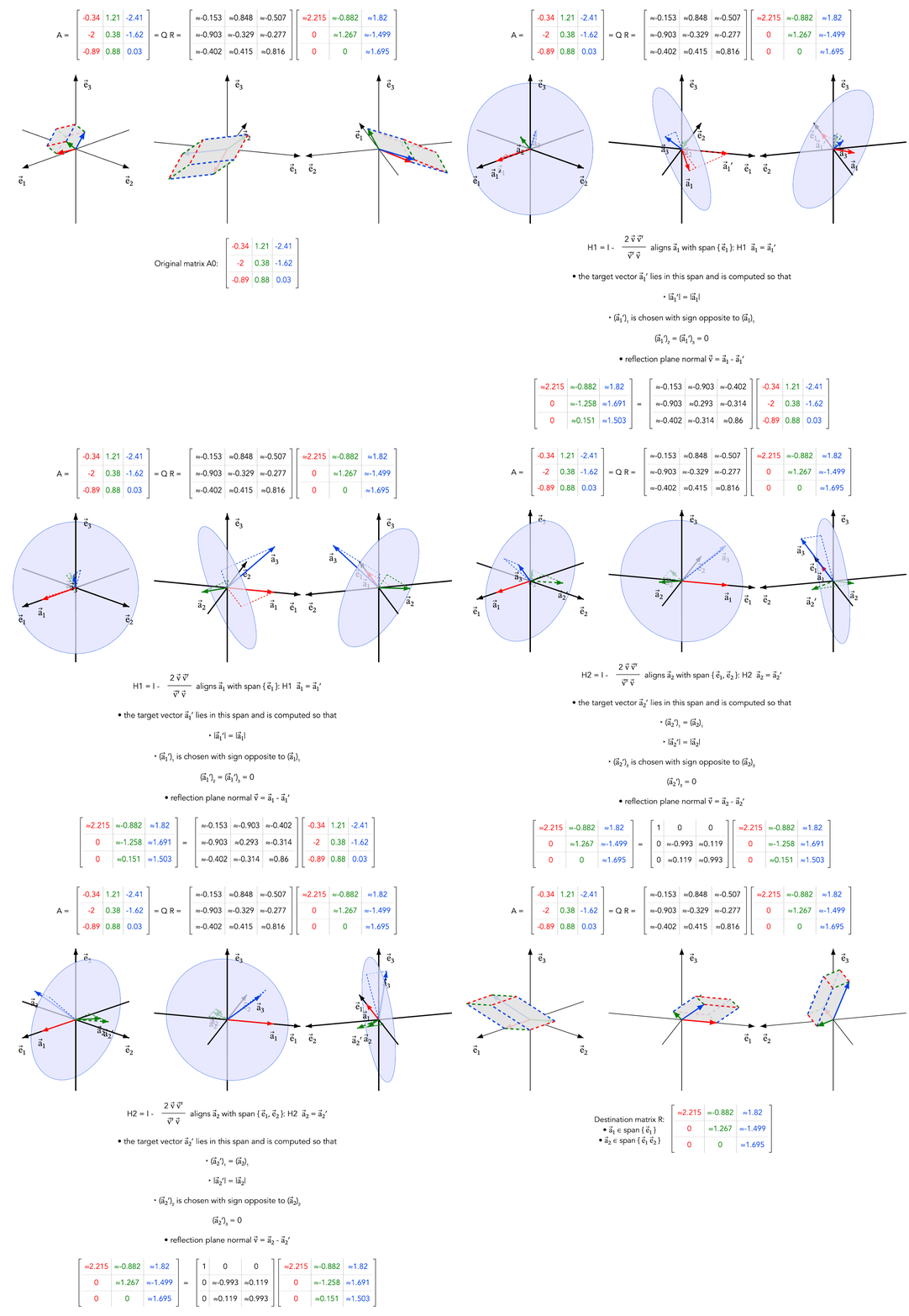
The animation shows a 3×3 matrix A and its QR factorization.
The original column geometry is transformed by a Householder reflection so that the active column aligns with a coordinate direction.
The reflected geometry explains how a single orthogonal reflection can zero multiple entries below a pivot at once.
Concept
A Householder reflection has the form H = I − 2uuT, where u is a unit vector.
It reflects space across the hyperplane perpendicular to u.
Vectors in the reflecting hyperplane stay fixed, while the component in the u direction changes sign.
With a suitable choice of u, the reflection sends a given vector to a coordinate axis.
Structure
In QR factorization, successive Householder reflections transform A into an upper triangular matrix R.
The accumulated orthogonal transformations give the factor Q.
Compared with Givens rotations, which eliminate selected entries one at a time, a Householder reflection acts on a whole column direction and can remove several lower components in one step.