Why Cramer’s Rule Works: Geometric Derivation in R², R³ and Rⁿ
Cramer's rule expresses each solution coordinate of A x = b as a determinant ratio.
This page visualizes why those ratios appear: replacing one column of A by b changes the signed volume by exactly the corresponding coordinate factor.
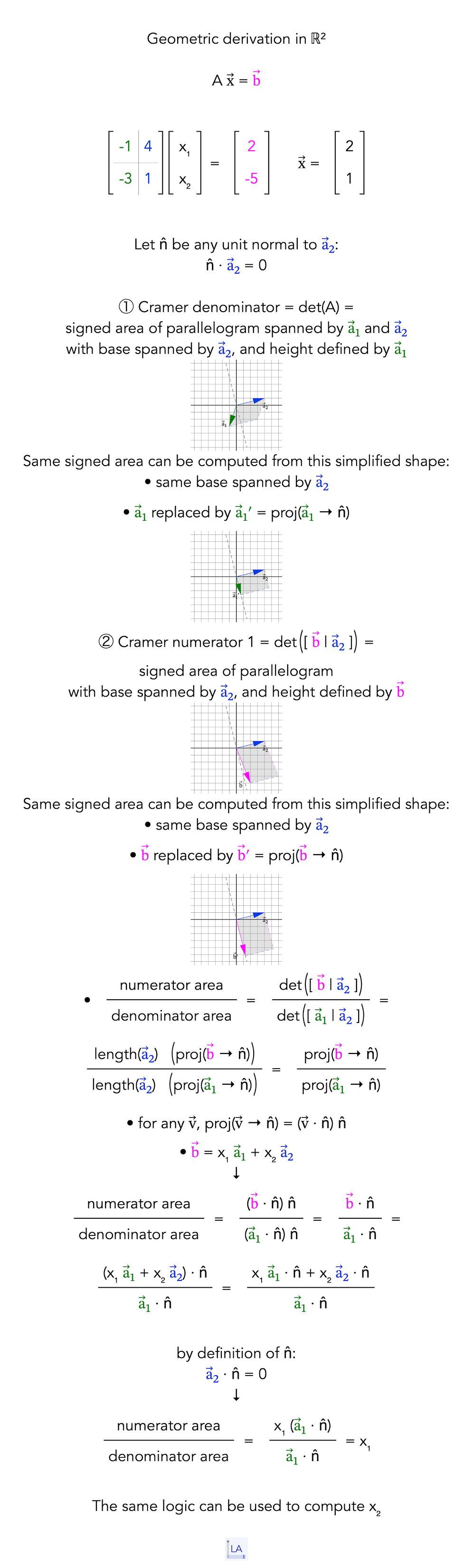
The first diagram shows the geometric derivation in R² using signed areas.
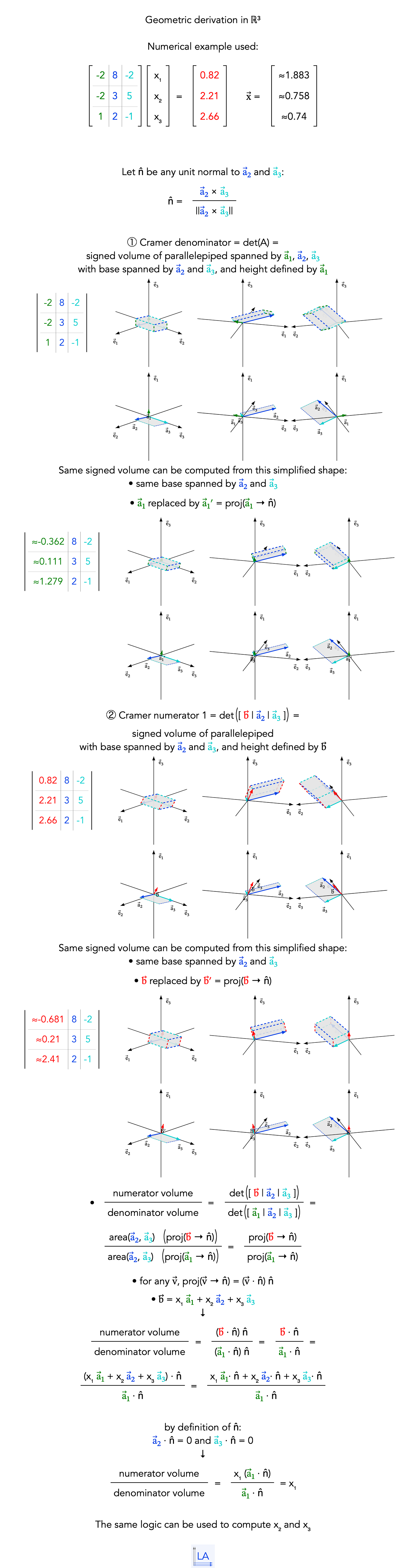
The second diagram shows the same idea in R³ using signed volumes.
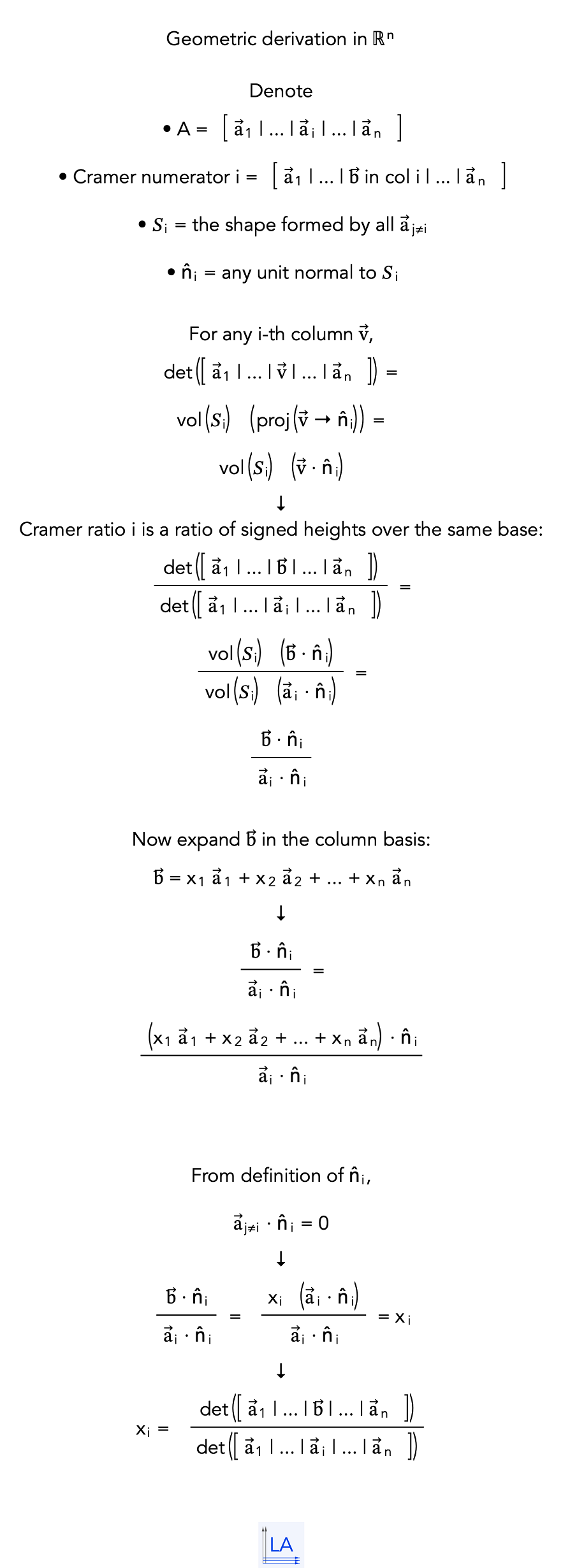
The third diagram shows the corresponding determinant-ratio argument in Rⁿ.
Geometric derivation in R²
In two dimensions, the determinant is signed area.
Replacing one column by b isolates one coordinate because the area scales by that coordinate while the remaining direction stays fixed.
Click the image to open the full-size version.
Geometric derivation in R³
In three dimensions, the determinant is signed volume.
Replacing one column by b isolates one coordinate because the volume scales by that coordinate while the remaining column directions stay fixed.
Click the image to open the full-size version.
Geometric derivation in Rⁿ
The same argument works in any dimension.
Expanding b in the column basis of A and using multilinearity of the determinant leaves only the term where b replaces the selected column.
Click the image to open the full-size version.
Concept
The columns of A form the coordinate directions used to build b.
If b = x₁a₁ + x₂a₂ + ... + xₙaₙ, then replacing column k by b produces a determinant in which all terms vanish except the one containing xkak.
Therefore det(Ak) = xk det(A), where Ak is obtained from A by replacing column k with b.
Dividing by det(A) gives the Cramer's rule formula.
Structure
The R² picture emphasizes signed area and the projection-height interpretation.
The R² picture emphasizes signed area and the projection-height interpretation.
The 3D picture emphasizes signed volume.
The Rⁿ picture emphasizes the same determinant properties algebraically: multilinearity and the fact that a determinant becomes zero when two columns are equal or linearly dependent.
Together they show that Cramer's rule is not just a computational formula, but a determinant-based way to isolate one coordinate at a time.