Powers of a 2D Matrix with Complex Eigenvalues: Visualizations
These two visual summaries show how repeated powers of a real 2D matrix behave when the matrix has complex eigenvalues.
The first emphasizes the factorization point of view, while the second emphasizes the geometric effect on repeated iterates.
Together they show that matrix powers can be understood as repeated rotation-scaling, viewed in a suitable basis.
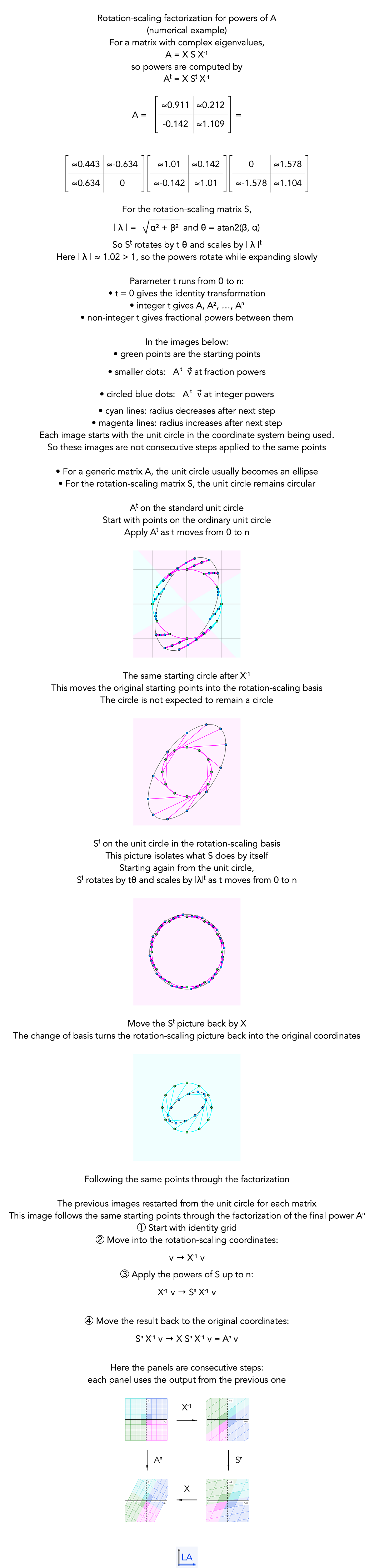
Factorization view of Ak
This diagram organizes the power computation through a change of basis and a rotation-scaling core.
Instead of treating each power as a separate multiplication, it highlights the repeated structure behind
Ak and shows how the complex-eigenvalue case can still be interpreted geometrically for real 2D matrices.
Click for the full-size image.
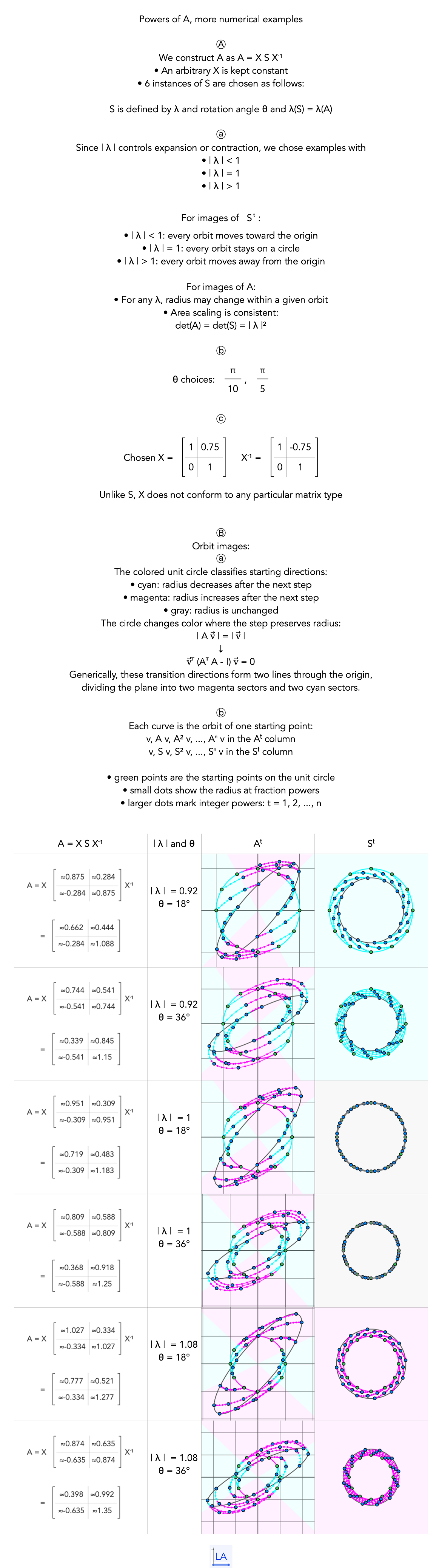
Orbit view of repeated powers
This diagram focuses on the geometric motion of vectors under repeated application of the matrix.
Depending on the scaling part, the iterates may spiral inward, stay on a closed orbit, or spiral outward,
while the rotational part keeps turning the vector at each step.
Click for the full-size image.
Concept
When a real 2D matrix has complex eigenvalues, there is no nonzero real vector that stays on a fixed line under the transformation.
Even so, the matrix can still act in a highly structured way: in a suitable basis it behaves like a rotation combined with scaling.
That is why its powers produce systematic turning and expansion or contraction, rather than arbitrary motion.
Why these visuals help
The factorization view explains how the powers are organized algebraically, while the orbit view explains what they do geometrically.
Seeing both together makes it easier to connect the formulas for matrix powers with the visible behavior of iterated transformations.