Row Reduction as Multiplication by Elementary Matrices
Row reduction is often introduced as a sequence of row operations, but each row operation is also multiplication on the left by an elementary matrix. This turns Gaussian elimination into a product of simple invertible transformations.
The same algebraic sequence can be visualized in two complementary ways: by tracking how all columns move under left multiplication, or by tracking how row normal planes and row vectors change.
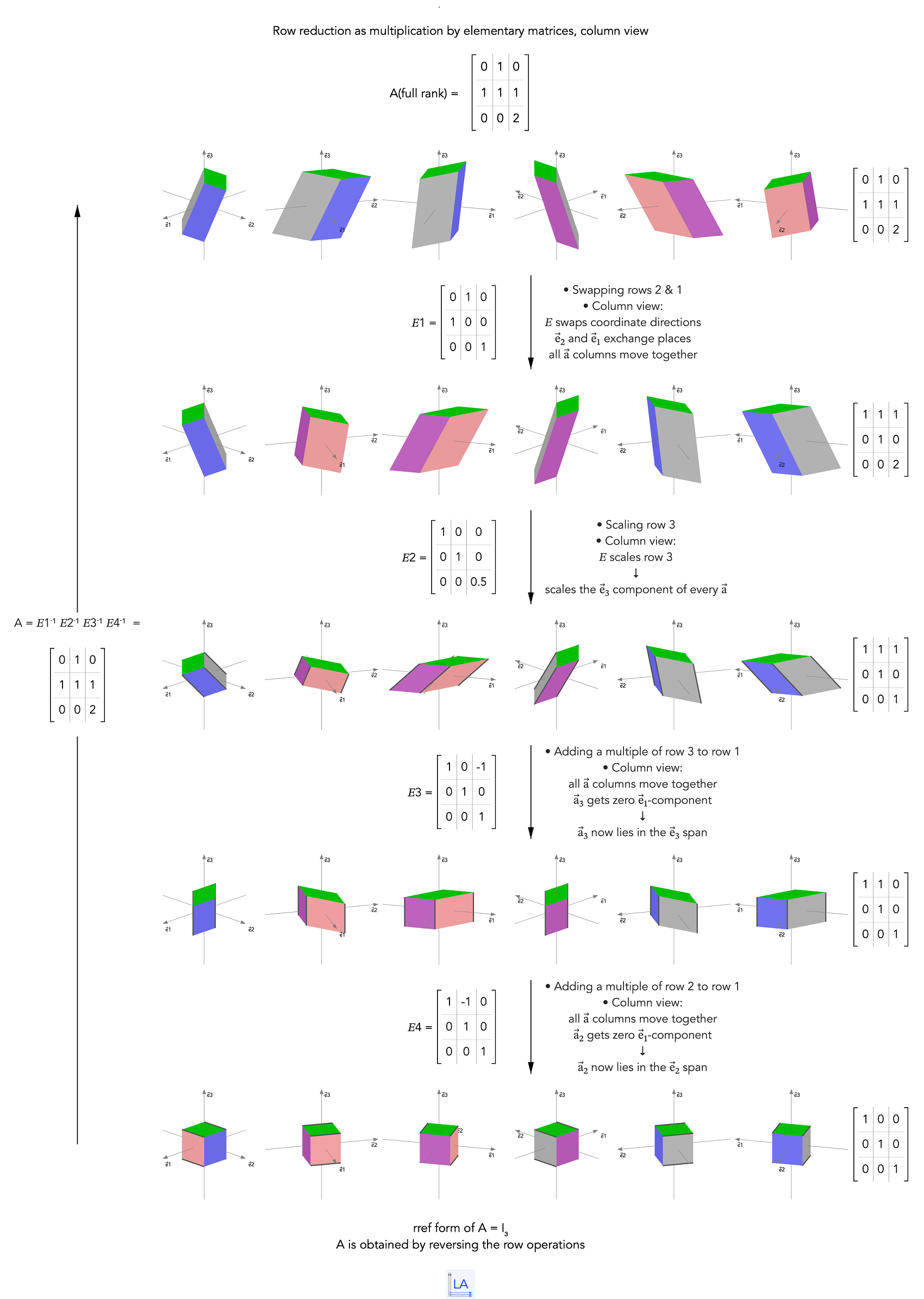
Column view
Left multiplication by an elementary matrix acts on every column of the matrix. In the column view, all columns move together as the row operations are applied.
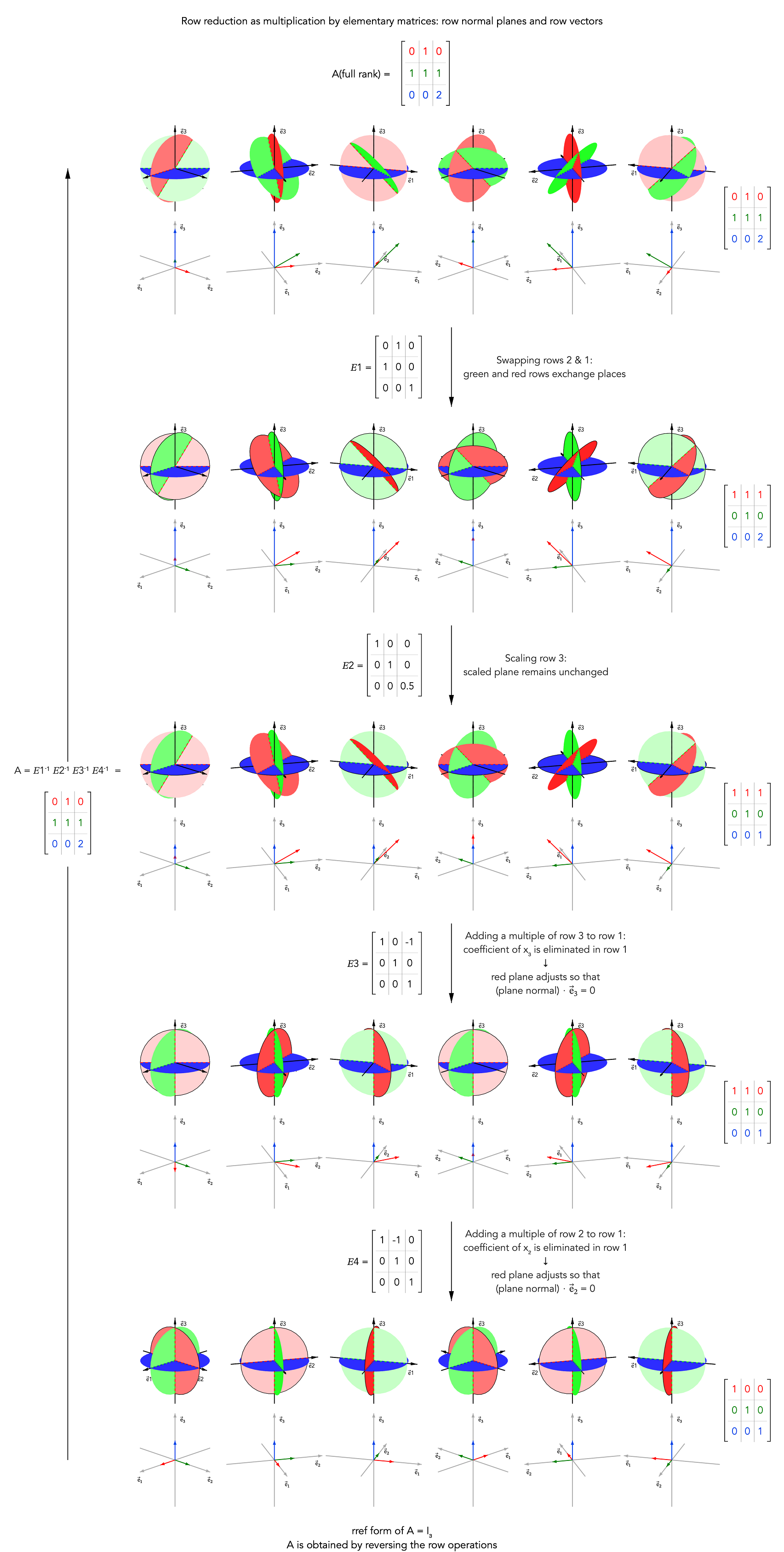
Row normal planes and row vectors
Row operations directly change the equations represented by the rows. In the row view, row normal planes and row vectors show how each operation updates the row geometry.
Concept
If the elementary matrices are E₁, E₂, …, Eₖ, then row reduction can be written as R = Ek ··· E2E1A. The reduced matrix R is produced by multiplying the original matrix A on the left.
Since elementary matrices are invertible, the original matrix can also be rebuilt by reversing the row operations: A = E1−1E2−1 ··· Ek−1R.
Key equations
These equations explain why a row-reduction algorithm can be interpreted as a sequence of geometric transformations.
Query phrases
- row reduction as multiplication by elementary matrices
- Gaussian elimination elementary matrices visualization
- row operations as left multiplication
- column view of row reduction
- row normal planes row reduction visualization
References
Related chapter: GraphMath — Row reduction