Gram-Schmidt Orthogonalization — Stepwise Visualization in 2D and 3D
Gram-Schmidt orthogonalization transforms a set of independent columns into an orthogonal, then orthonormal, basis. The process can be viewed not only as a symbolic algorithm, but also as a sequence of geometric changes in space.
The visualizations below show the algorithm step by step in two and three dimensions, together with a structural summary of what gradual orthogonalization reveals.
Overview
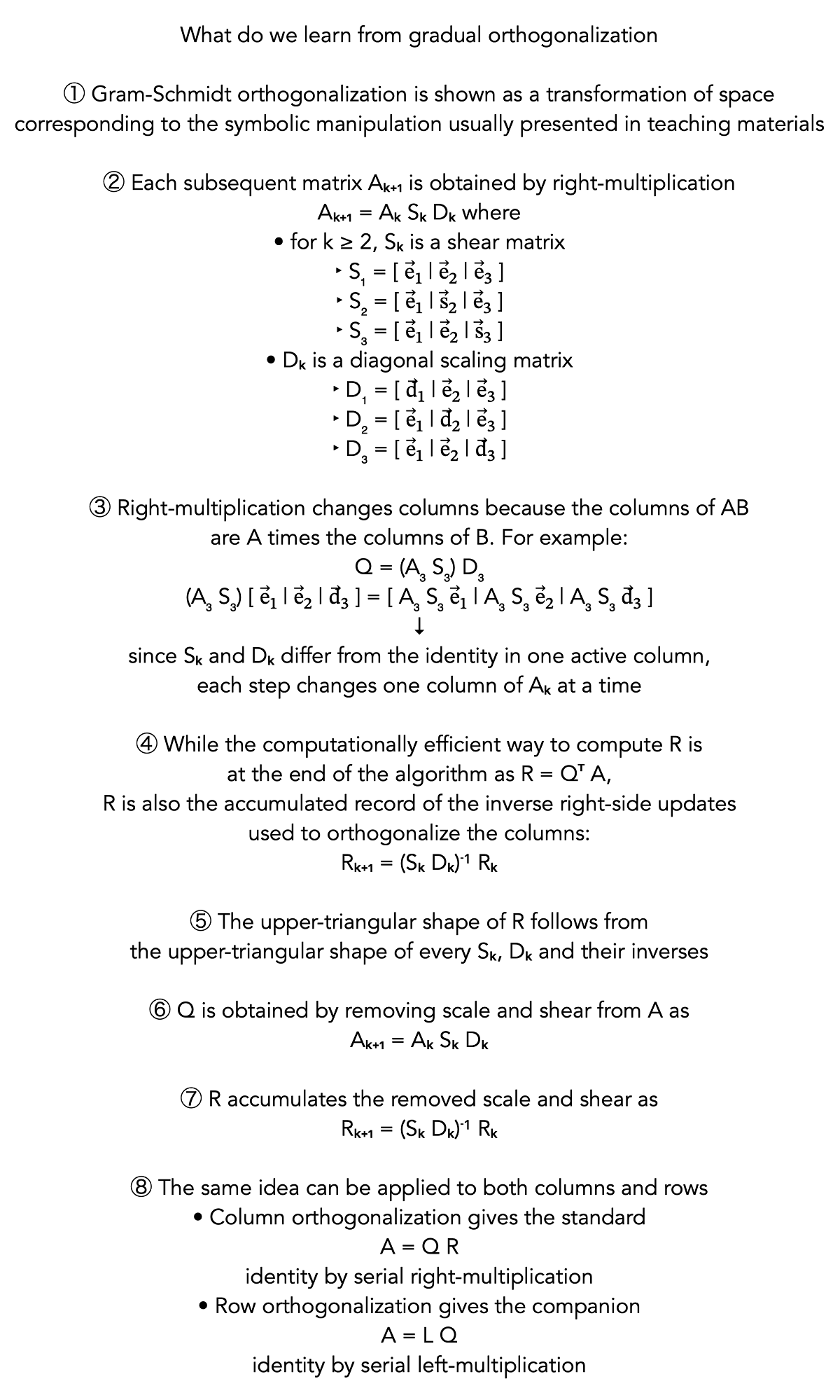
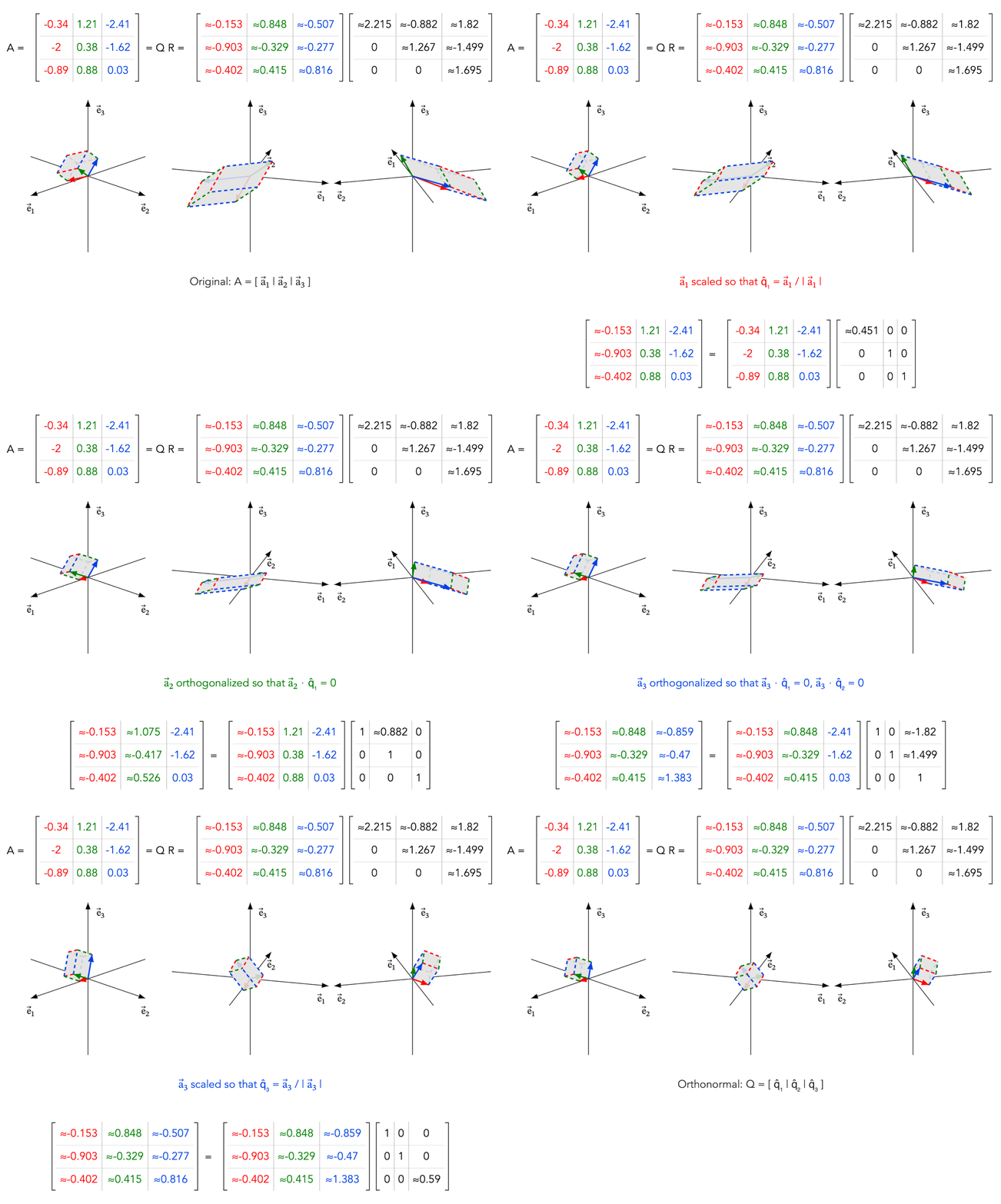
One useful way to view Gram-Schmidt is as a sequence of right-side updates that change one active column at a time. In this interpretation, scale and shear are removed step by step from the original matrix, producing the orthonormal matrix Q, while the removed transformations accumulate into the upper-triangular factor R.
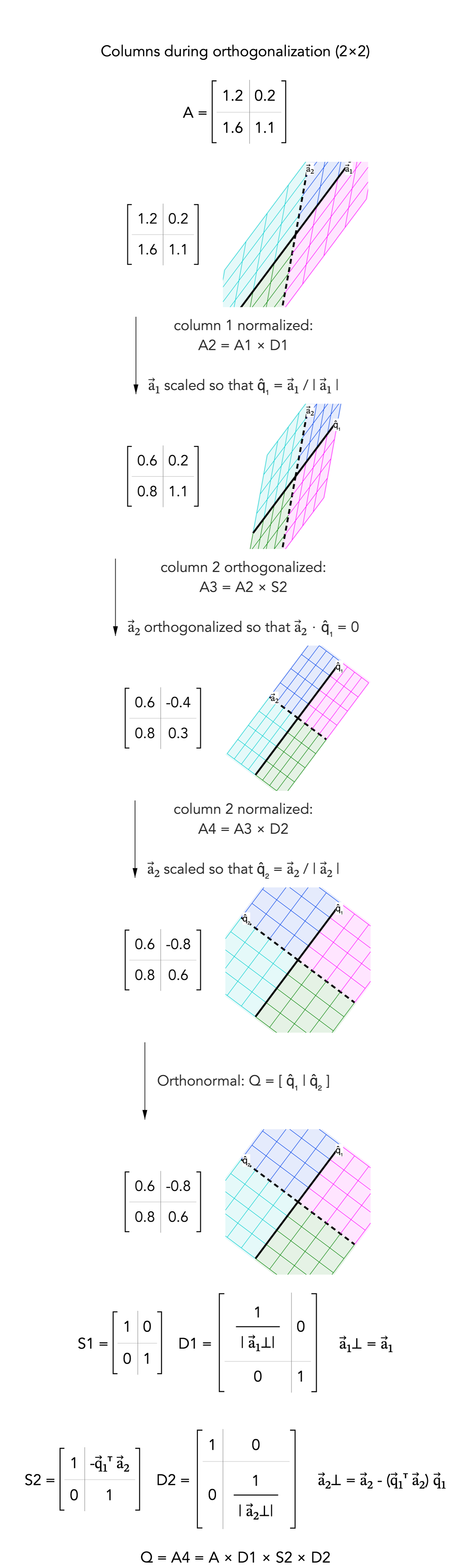
Stepwise orthogonalization in 2D
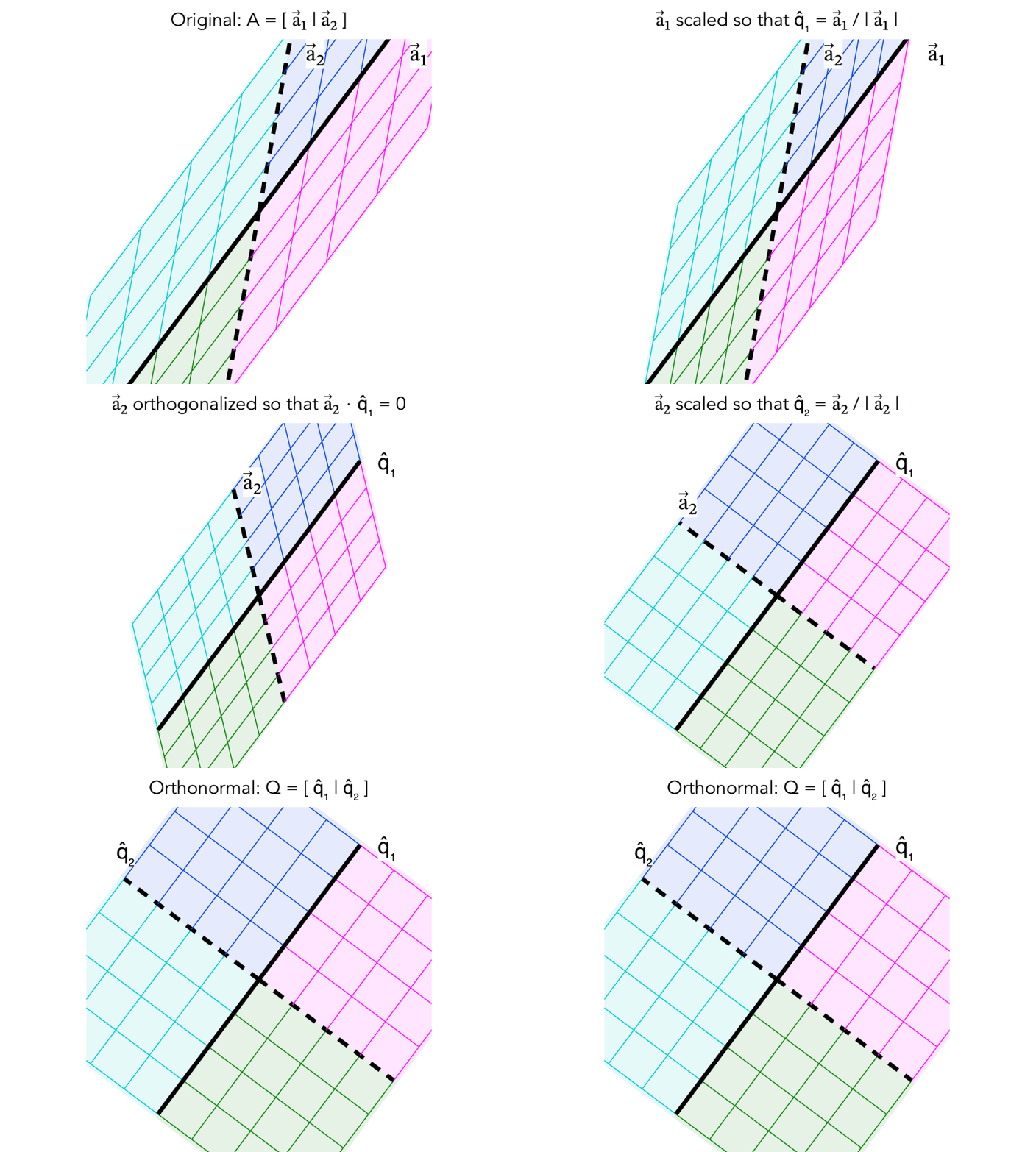
In two dimensions, the first column is normalized, then the second is orthogonalized against it and normalized. The static diagram shows the sequence as a chain of intermediate matrices, while the animation shows the same process unfolding continuously.
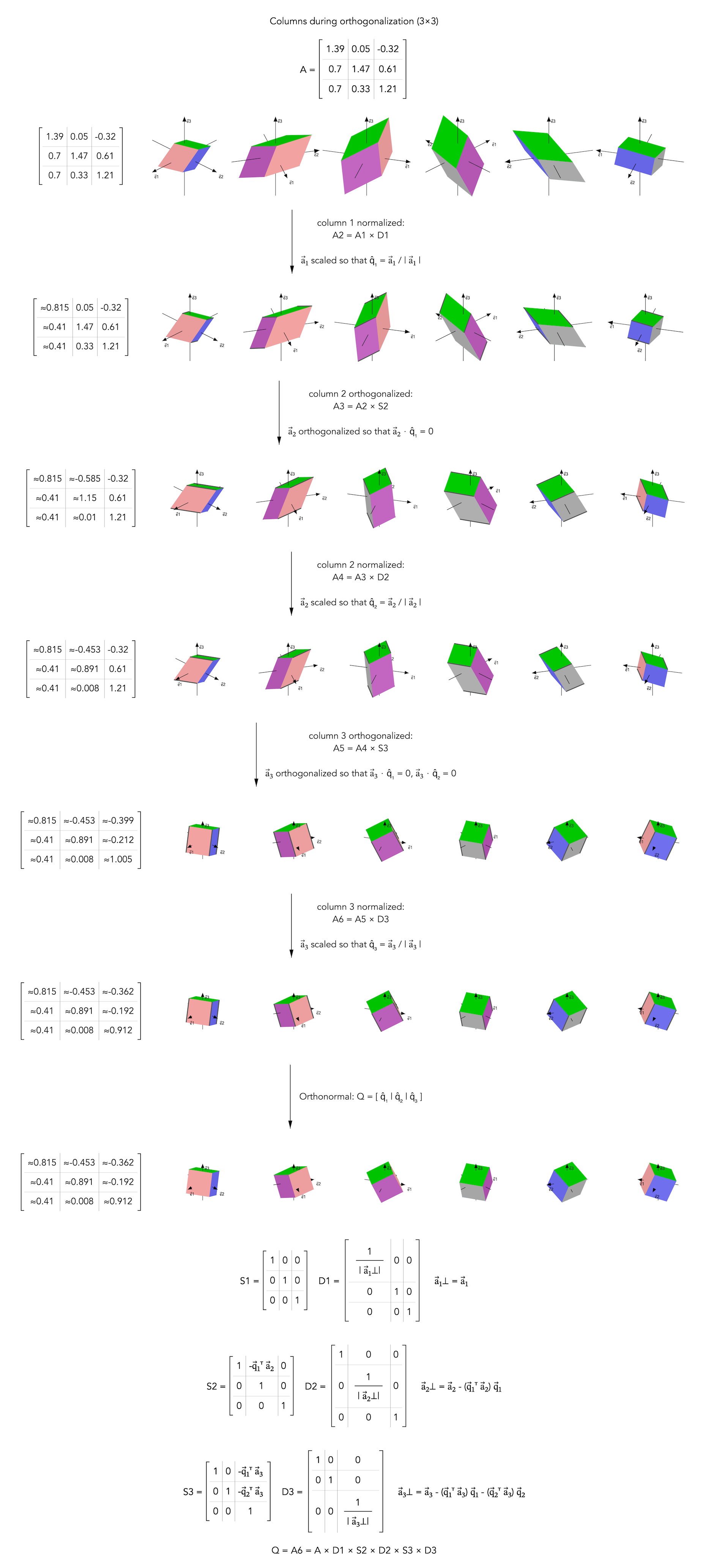
Stepwise orthogonalization in 3D
In three dimensions, the same logic continues one column at a time. After the first normalization, the second column is made orthogonal to the first, then normalized, and finally the third is corrected against the first two and normalized.
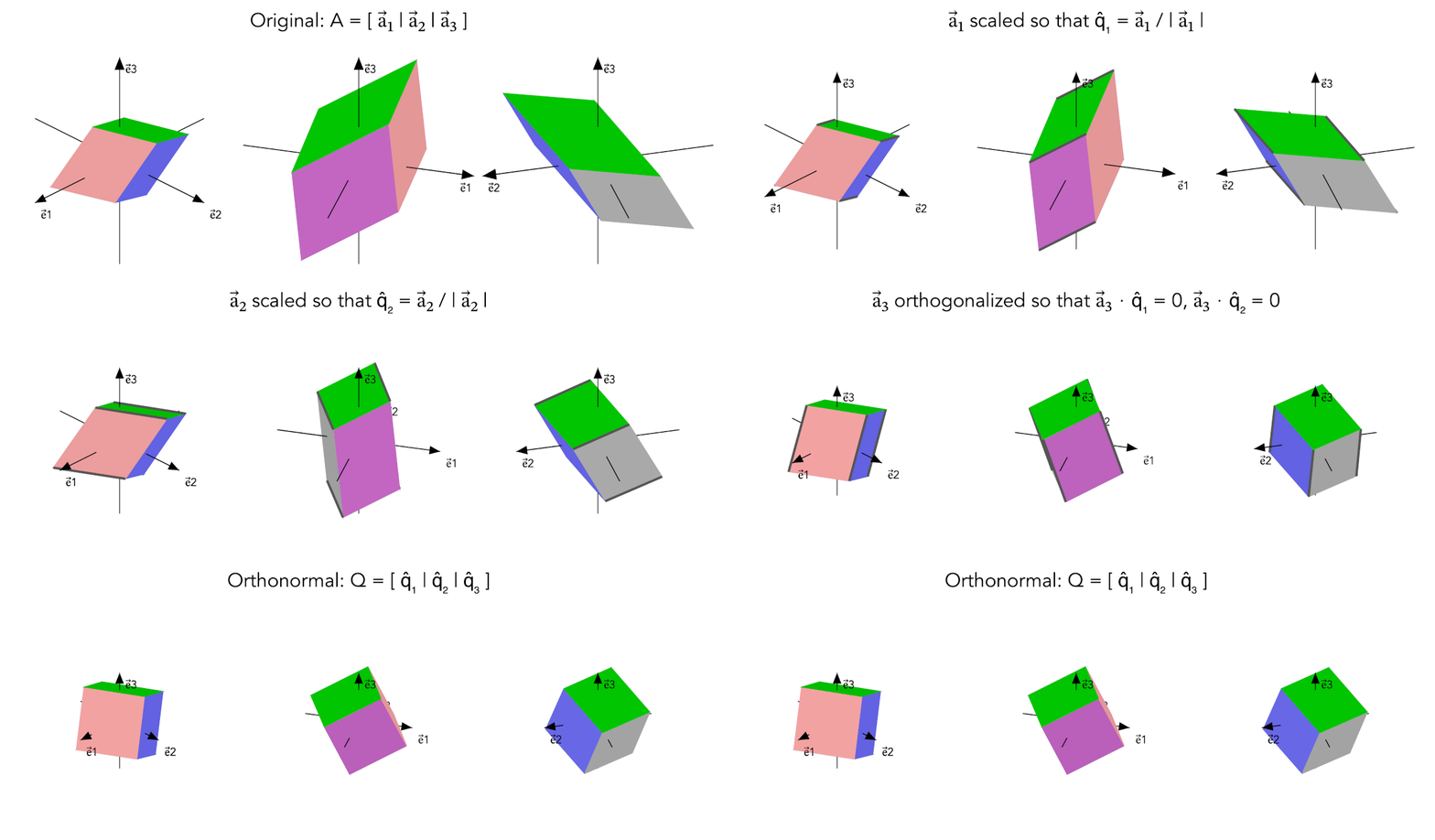
Gram-Schmidt orthogonalization visualized as semi-transparent cubes (same matrix)
This animation shows the same 3D Gram-Schmidt process with a different visual representation. Semi-transparent cubes with coordinates in the interval [0, 1] make the motion and final destinations of the vectors easier to visualize.
Concept
Gram-Schmidt converts independent columns into orthonormal columns. In matrix form, this produces the factor Q of QR decomposition, while the coefficients used during the process are recorded in the upper-triangular factor R.
These images emphasize the process viewpoint: the columns are not replaced all at once, but are corrected and normalized in a definite order, with each step acting on one active column.
Key equations
The geometric process shown above is another way to understand these symbolic updates.
Query phrases
- Gram-Schmidt stepwise visualization
- Gram-Schmidt orthogonalization animation
- how Gram-Schmidt works geometrically
- Gram-Schmidt in 2D and 3D
- step by step QR construction
References
Related concept page: GraphMath — QR Decomposition, Geometric Interpretation in 2D and 3D
Related chapter: GraphMath — QRF, Gram-Schmidt, part 3