Eigenvectors: Definition and Transformation Examples
A nonzero vector x⃗ is an eigenvector of a matrix A when multiplication by A leaves it on the same line. The scalar λ is the corresponding eigenvalue.
Definition and examples
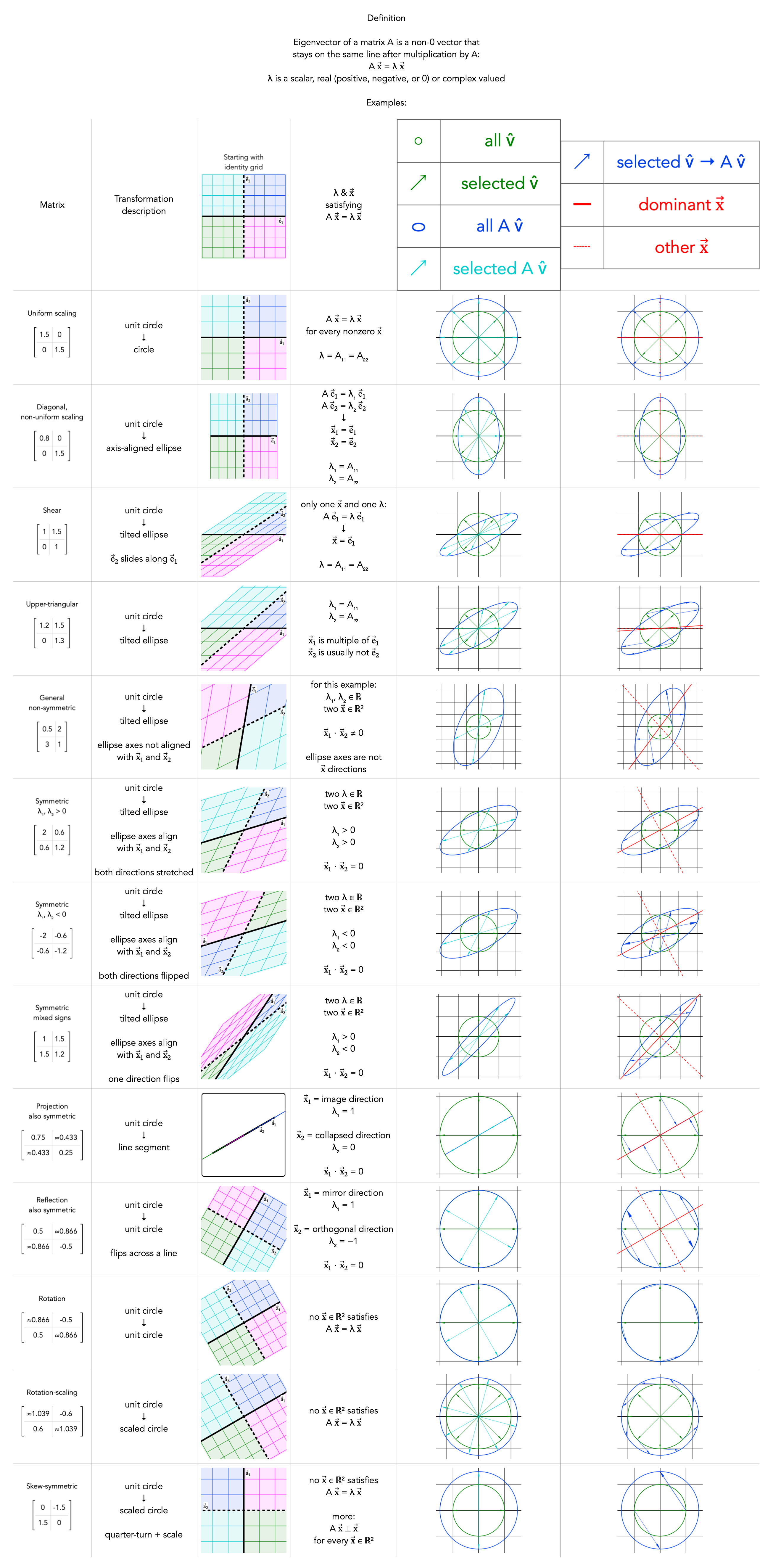
Concept
The equation A x⃗ = λx⃗ says that the transformation acts on the eigenvector direction as a one-dimensional scaling. The vector may be stretched, shrunk, reversed or collapsed, but it is not turned away from its original line.
Structure
Uniform scaling preserves every direction. Nonuniform diagonal scaling preserves the coordinate axes. A shear typically preserves one direction. A real symmetric matrix has orthogonal eigenvector directions. Projection preserves one subspace and collapses its orthogonal complement, while reflection preserves one direction and reverses the perpendicular one.
A genuine 2D rotation generally has no real eigenvectors because every nonzero real vector changes direction.
Key equations
Query phrases
- eigenvector definition visualized
- geometric meaning of eigenvectors
- eigenvectors of common transformations
- eigenvectors of scaling shear projection reflection rotation
- what does A x equals lambda x mean
- why rotation has no real eigenvectors
- eigenvalue geometric interpretation