Visual Guide to Diagonalizable 2×2 Matrices
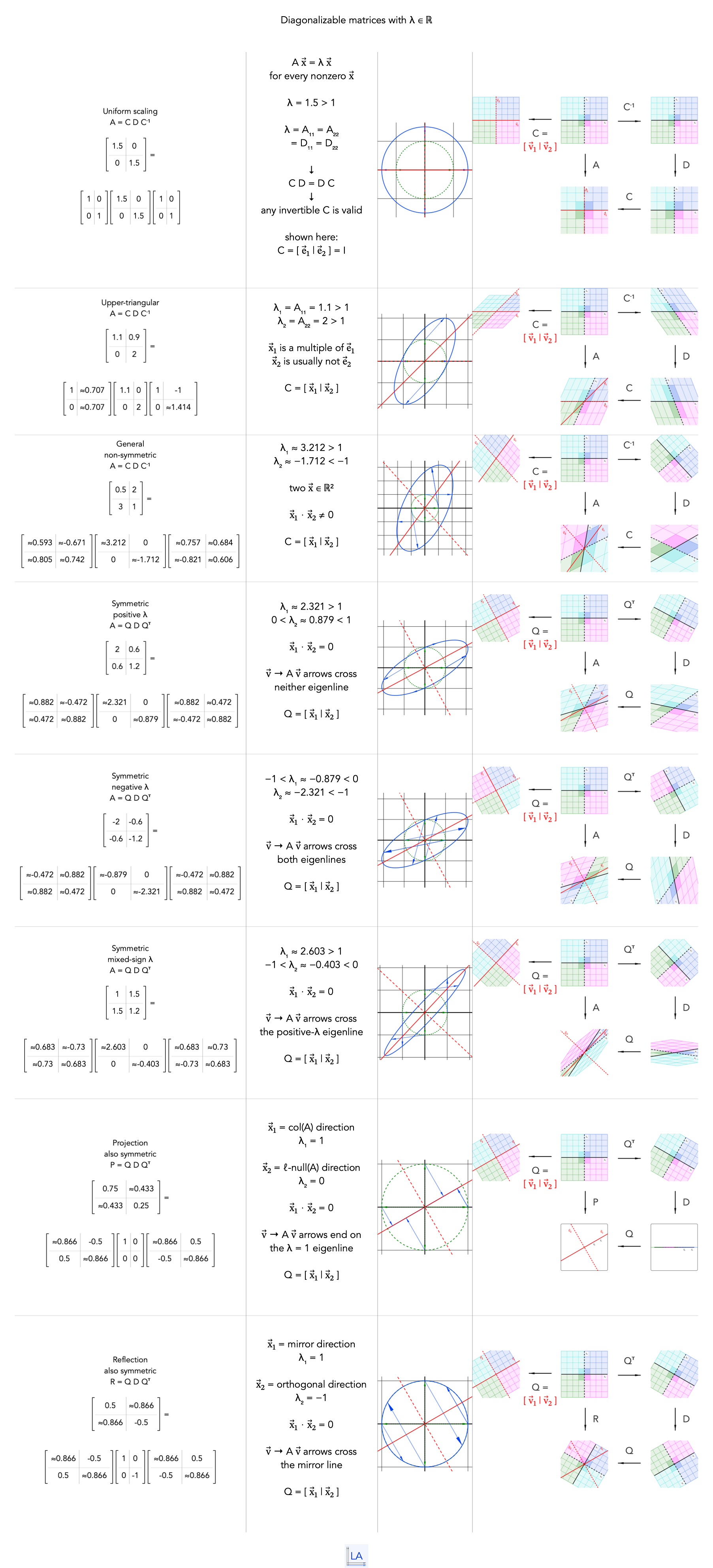
A 2×2 matrix is diagonalizable when it has two linearly independent eigenvectors. Those eigenvectors form a basis in which the transformation acts by independent scalings.
Diagonalizable 2×2 matrices
Concept
If the columns of C are eigenvectors of A, then C−1 changes coordinates to the eigenvector basis. In that basis, A becomes the diagonal matrix D, whose diagonal entries are the corresponding eigenvalues.
Structure
Diagonalization separates the transformation into three stages: move into the eigenvector basis, scale independently along the eigenvector directions, and return to the original basis. This is the meaning of A = C D C−1.
For a real symmetric matrix, the eigenvectors can be chosen orthonormally. Then C becomes an orthogonal matrix Q, and the factorization simplifies to A = Q D QT.
Key equations
Query phrases
- visual guide to diagonalizable 2×2 matrices
- diagonalization visualized
- geometric meaning of A equals C D C inverse
- eigenvector basis visualization
- change of basis diagonalization
- diagonalization of symmetric matrices
- orthogonal diagonalization visualized