Summary table
The columns compare the main shape-and-rank cases. The rows show domain decomposition, codomain decomposition, one-to-one and onto behavior, reduced echelon form, solution structure, determinant, inverse and pseudoinverse behavior.
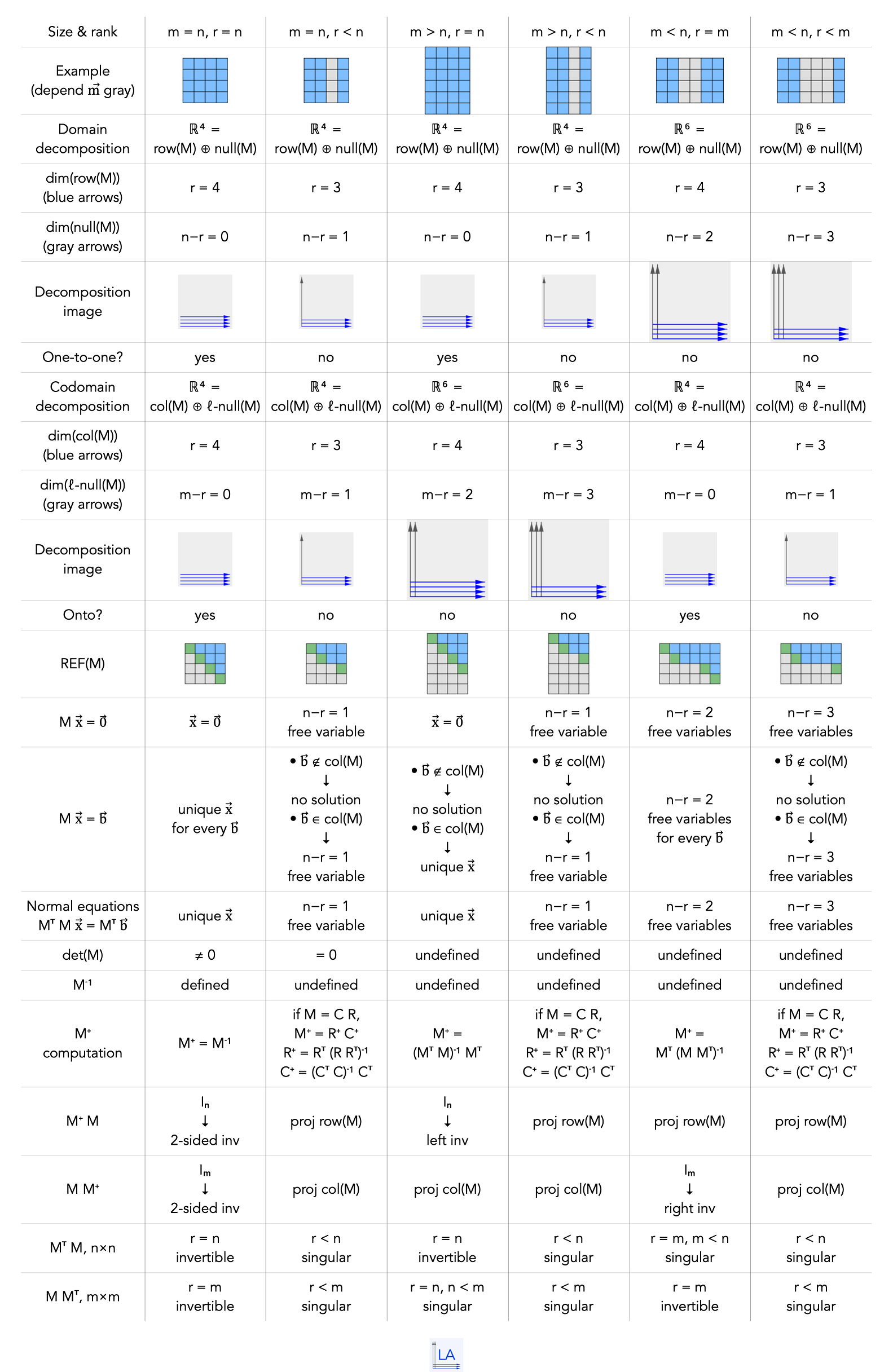
Matrix shape and rank determine many structural facts at once. This visual table compares the main square, tall and short matrix cases and shows how rank controls null space, left null space, one-to-one behavior, onto behavior, solvability, determinant, inverse and pseudoinverse structure.
This visualization summarizes the main matrix shape-and-rank cases in one table, so the consequences of full rank, rank deficiency, tall shape and short shape can be compared directly.
The table is large and dense. Click the image to open the full-size version.
The columns compare the main shape-and-rank cases. The rows show domain decomposition, codomain decomposition, one-to-one and onto behavior, reduced echelon form, solution structure, determinant, inverse and pseudoinverse behavior.
For an m × n matrix M of rank r, the row space and column space both have dimension r. The null space has dimension n − r, and the left null space has dimension m − r.
Those two missing dimensions explain the main cases. If n − r = 0, the transformation is one-to-one. If m − r = 0, the transformation is onto.
The table separates square full-rank, square rank-deficient, tall full-column-rank, tall rank-deficient, short full-row-rank and short rank-deficient matrices. Each case has a different combination of free variables, unreachable outputs, determinant behavior and inverse or pseudoinverse structure.
The visual purpose of the table is to make these consequences comparable in one place rather than treating them as separate facts.
Related chapter: Shape & rank
Related work: GraphMath Linear Algebra
Contact: info@graphmath.com
© 2026 GraphMath. This work is licensed under the Creative Commons Attribution 4.0 International License (CC BY 4.0) ; see licensing details.