Visualizing Rodrigues Rotation Formula
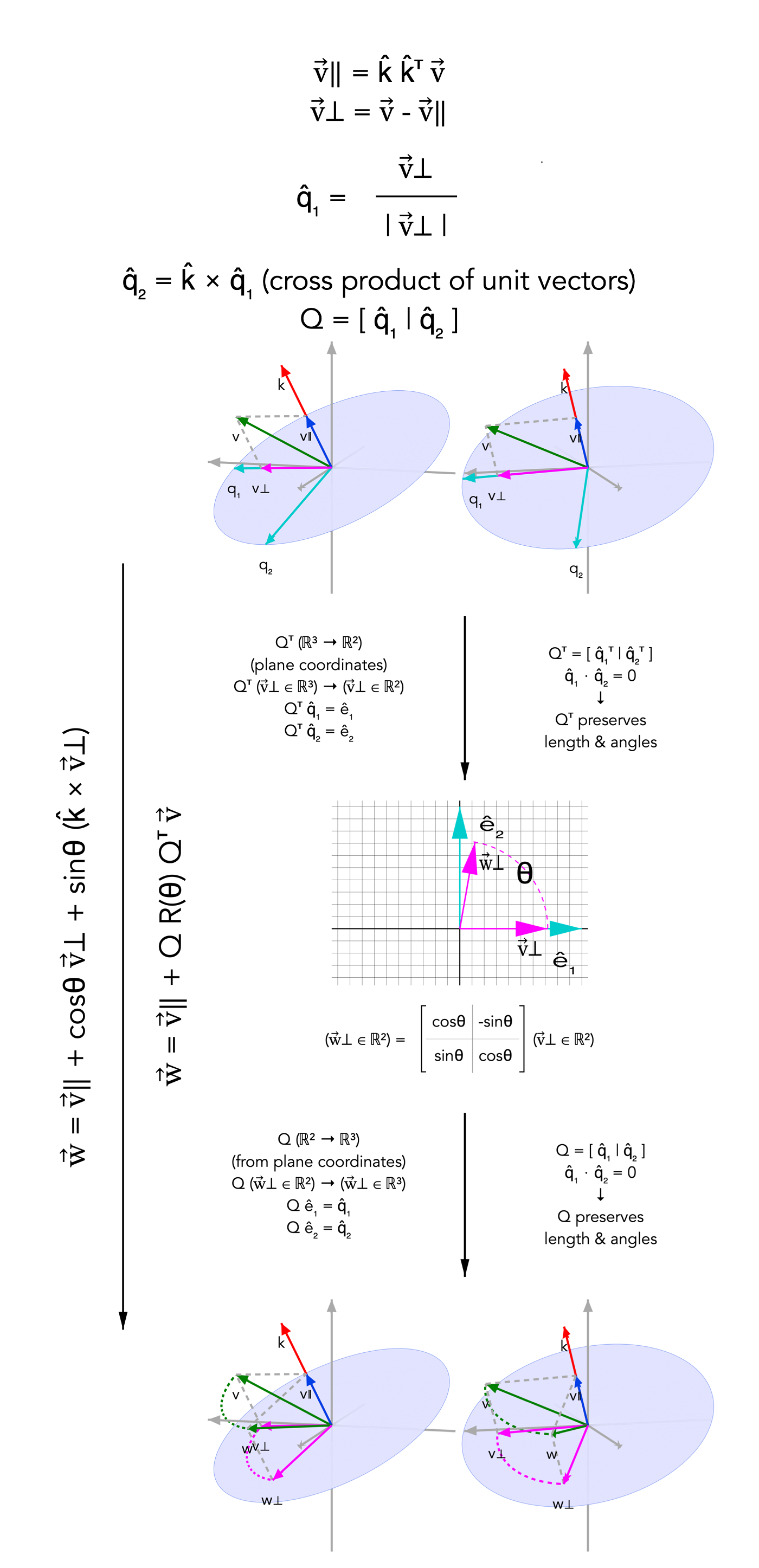
Rodrigues rotation formula rotates a vector v around a unit axis k̂ by splitting the vector into two parts:
the axial component parallel to k̂ and the planar component perpendicular to k̂.
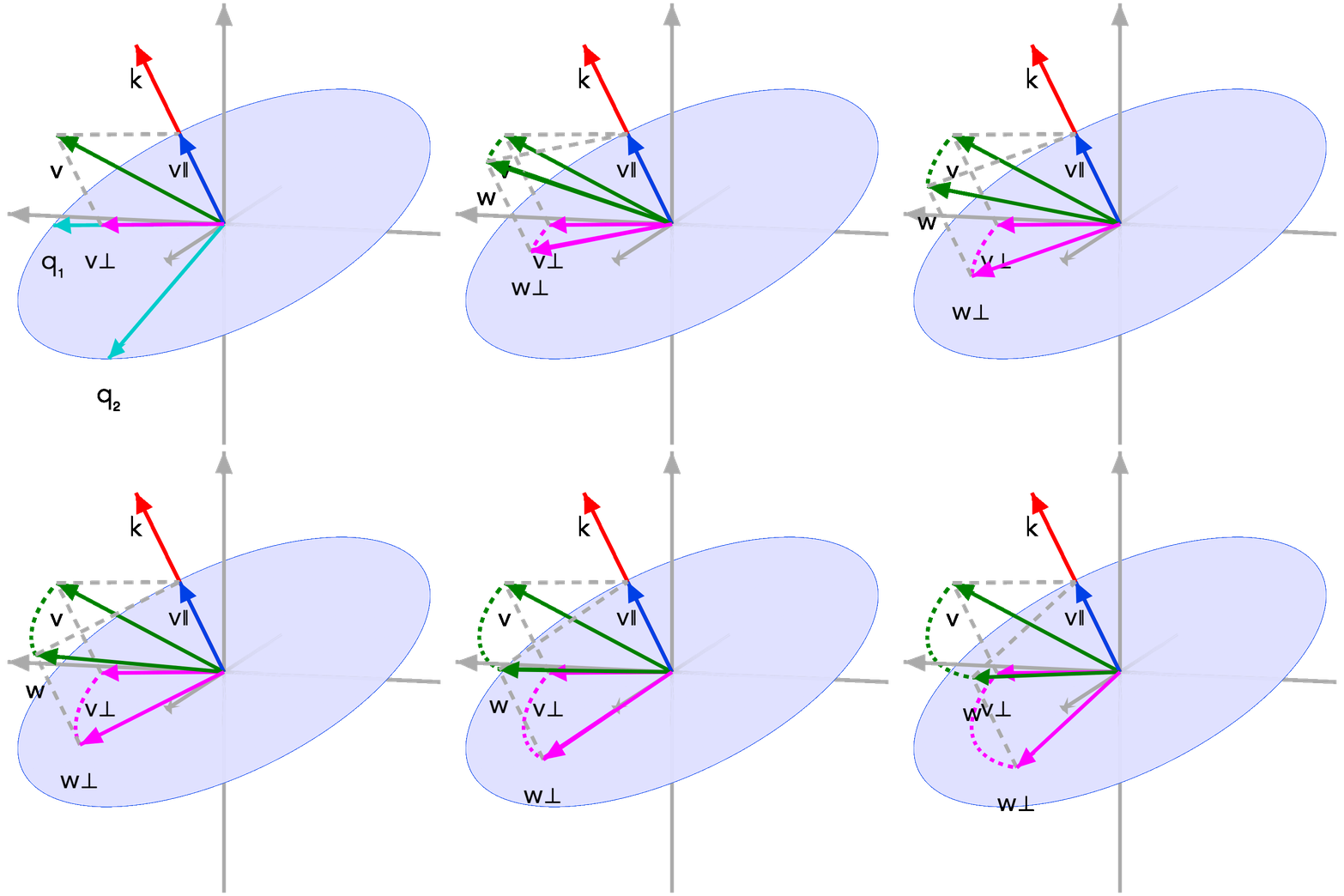
The parallel part stays fixed, while the perpendicular part rotates inside the plane orthogonal to the axis.
Step-by-step geometric construction
The construction begins by separating v into v∥ and v⊥, then building plane coordinates with an orthonormal basis in the rotation plane.
A 2D rotation by angle θ is applied in those plane coordinates, and the rotated planar part is mapped back to 3D before recombining with the unchanged axial component.
Rotation about a fixed axis
The animation shows the same structure dynamically: the vector rotates around the fixed axis, the axial component remains unchanged and only the perpendicular component sweeps through the rotation plane.
Concept
Let k̂ be a unit vector along the rotation axis and let v be any vector in ℝ³.
The axial component is v∥ = k̂ k̂ᵀ v and the perpendicular component is v⊥ = v − v∥.
The vector v∥ is already aligned with the axis, so it does not move under rotation about that axis.
The whole problem reduces to rotating v⊥ by angle θ inside the plane orthogonal to k̂.
Structure
Choose an orthonormal basis (q̂₁, q̂₂) for the rotation plane, where q̂₁ points along v⊥ and q̂₂ = k̂ × q̂₁.
Then the planar part can be expressed in 2D coordinates, rotated by the standard 2D rotation matrix and mapped back to 3D.
This separates 3D rotation into three pieces: keep the axial part, rotate in plane coordinates and recombine.