Direct Plane-Rotation View of a QR Step — Geometric Interpretation
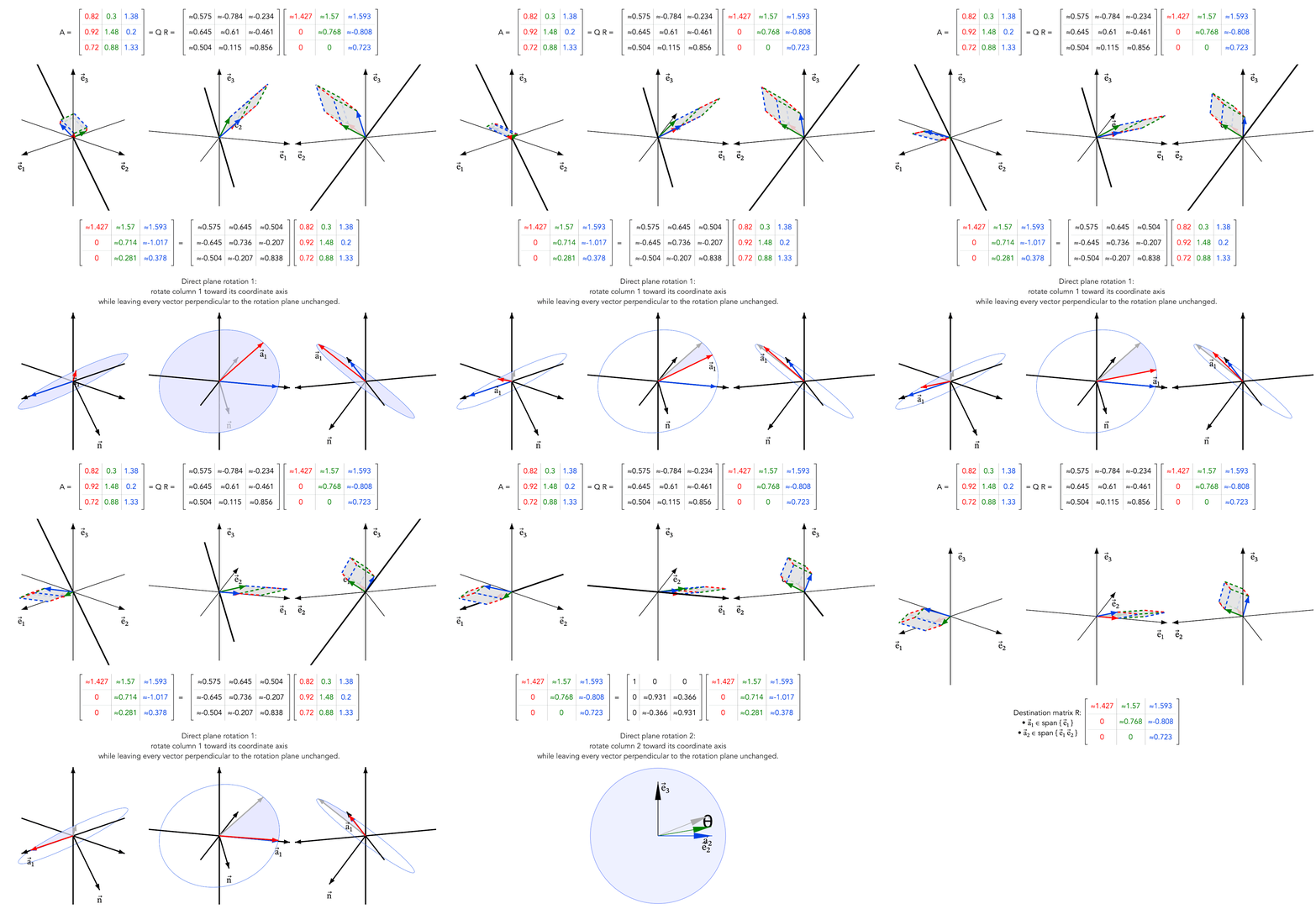
This animation represents one QR elimination step as a proper rotation in the two-dimensional plane
spanned by the active column and its leading coordinate vector.
The column is rotated toward the nearer of e₁ and −e₁, so the whole active part below the pivot is eliminated at once.
The main point is representational rather than algorithmic.
The corresponding Householder step acts in the same active plane and gives the same trailing matrix;
with the sign convention used here, the transformed matrices differ only in the sign of the completed pivot row.
Under construction.
The accompanying chapter develops the exact Householder relation and shows how the same active plane and signed angle can be recovered from standard packed Householder data.
One active plane and one signed angle
The animation follows the active-column process geometrically.
At each step, the active column and its target coordinate direction identify a plane;
a proper rotation acts only in that plane and leaves the orthogonal complement unchanged.
This makes the active plane and rotation angle explicit.
Those same geometric quantities are also recoverable from the corresponding Householder reflector.
Click the animation to open the full-size version.
Concept
Let a be the active column.
The vectors a and e₁ span a two-dimensional plane.
The shorter proper rotation sends a to the nearer signed coordinate direction σe₁, while every vector perpendicular to that plane remains unchanged.
Once the column is aligned, all active entries below the pivot are zero.
After deflation, the same geometric description can be applied to the next active column.
Connection to Householder reflection
The direct rotation and the corresponding Householder reflection act in the same two-dimensional plane and leave the same orthogonal complement unchanged.
If H is the Householder reflection and P is the orientation-correcting reflection in that plane, then
U = P H.
The distinction is therefore representational: Householder QR stores a reflector normal and scalar, while the direct-rotation form makes the active plane and signed rotation angle explicit.
What the representation makes explicit
Standard Householder QR stores a reflector normal and scalar.
The corresponding proper rotation, active plane and signed angle can be recovered from those data, but they are not represented explicitly.
The plane-angle representation exposes those geometric quantities directly.
In particular, the signed angle immediately gives a continuous orientation-preserving interpolation from the identity to the endpoint rotation.
Frequently asked questions
How is this different from Householder QR?
It is closely aligned with Householder QR.
The direct rotation and the corresponding Householder reflection act in the same two-dimensional plane and leave the same orthogonal complement unchanged.
The direct rotation can be written as the Householder reflection followed by an orientation-correcting reflection: U = P H.
The main distinction is therefore the representation: Householder QR uses a reflector normal and scalar, while the direct-rotation form makes the active plane and signed rotation angle explicit.
What changes after one Householder step versus one direct-rotation step?
With the sign convention used here, the transformed matrices differ only in the sign of the completed pivot row.
The trailing active matrix is the same, so the subsequent elimination steps are the same up to the corresponding row-sign convention.
Why keep the direct-rotation representation?
It makes the active plane and the signed rotation angle explicit.
Those quantities give a direct geometric interpretation and an immediate continuous, orientation-preserving path from the identity to the endpoint QR transformation.
Why is this not Givens QR?
Givens QR normally uses a sequence of coordinate-plane rotations and eliminates one subdiagonal entry at a time.
This representation uses one active plane and one proper rotation for the whole active column.
How are matrix multiplications avoided?
The rotation matrix is never formed.
Its action on the active matrix is reduced algebraically to a row-vector product and a rank-1 update.
Can the plane and angle be recovered from an ordinary Householder step?
Yes.
From the packed Householder pivot, scalar and reflector tail, the corresponding direct-rotation plane and signed angle can be reconstructed with work linear in the number of active rows.