Change of Basis — Derived from the Definition and Visualized
Change of basis does not change the vector itself. It changes only the coordinates used to describe that vector.
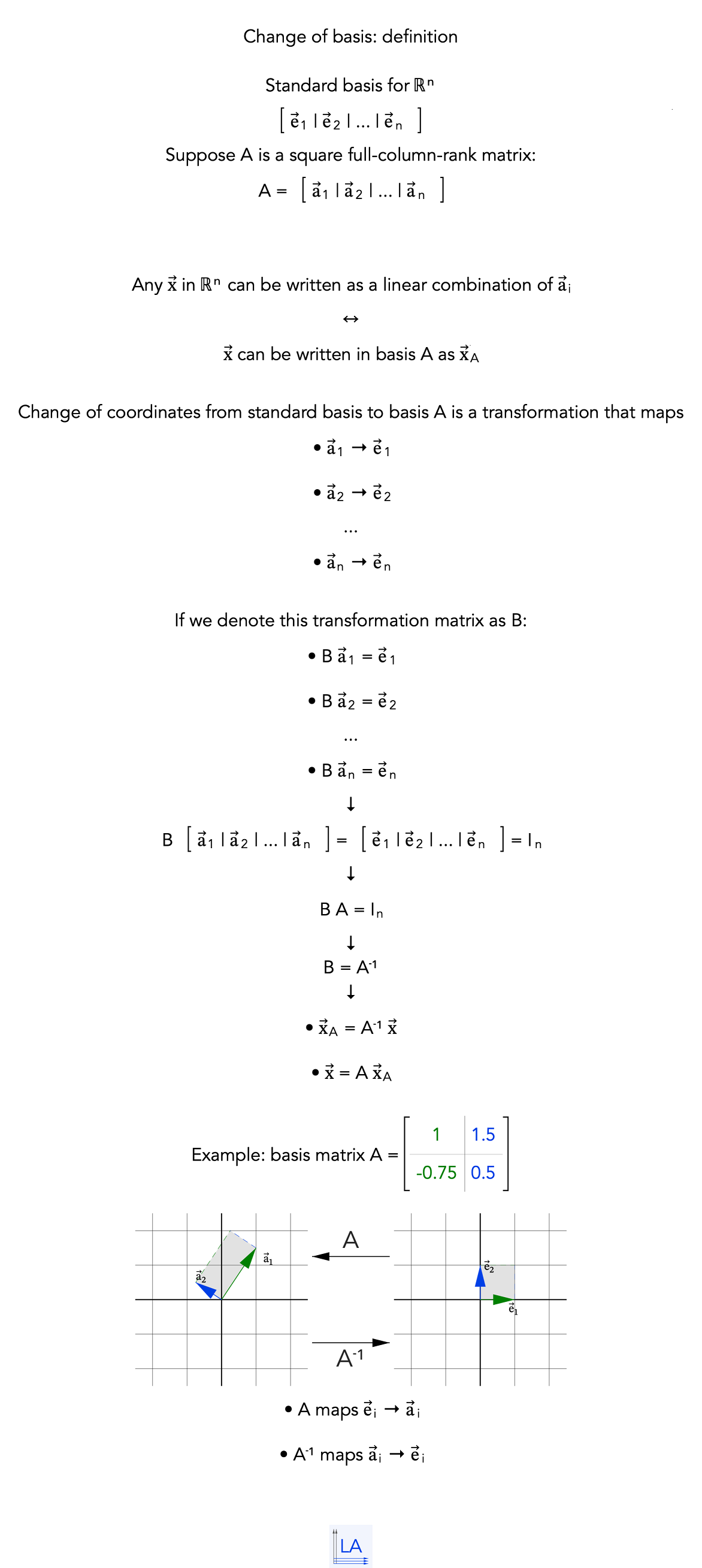
The first image derives the coordinate-change matrix from the definition of a basis.
The following images show the same vector represented first in the standard basis and then in another basis.
The coordinate column changes because the basis vectors change, but the geometric vector in the plane remains the same.
Change of basis derived from the definition
Starting with a square full-column-rank basis matrix A = [a₁ | a₂ | ... | aₙ],
the change of coordinates from basis A to the standard basis is determined by how the basis vectors are mapped.
Since A maps standard coordinate vectors to the basis vectors, the inverse A−1 maps those basis vectors back to the standard coordinate directions.
Click the image to open the full-size version.
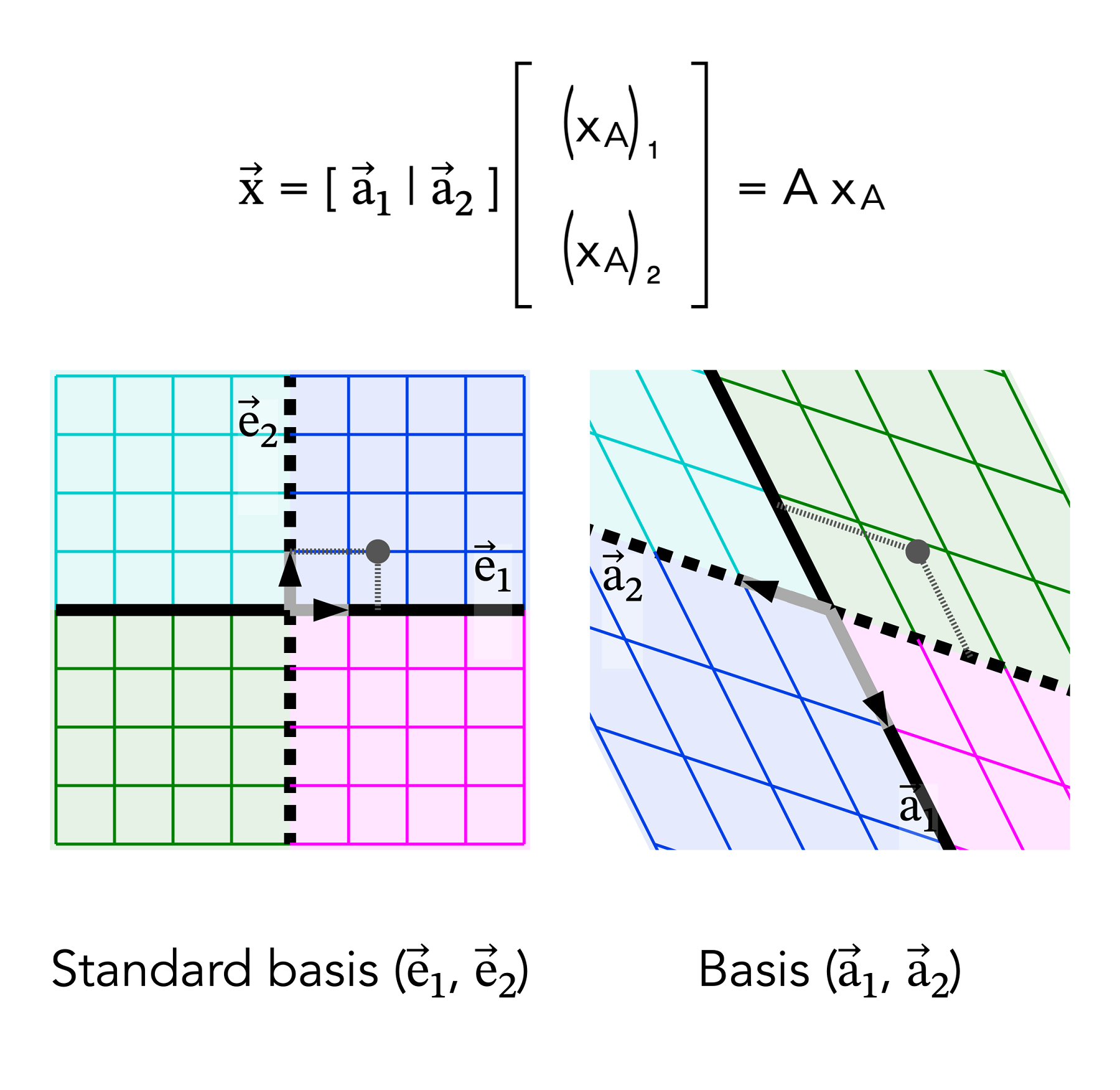
Coordinates in one nonstandard basis
The same vector can be described either in the standard basis or in the basis (a₁, a₂).
Writing x = A xA means that the columns of A are the basis vectors,
while xA stores the coordinates relative to that basis.
Click the image to open the full-size version.
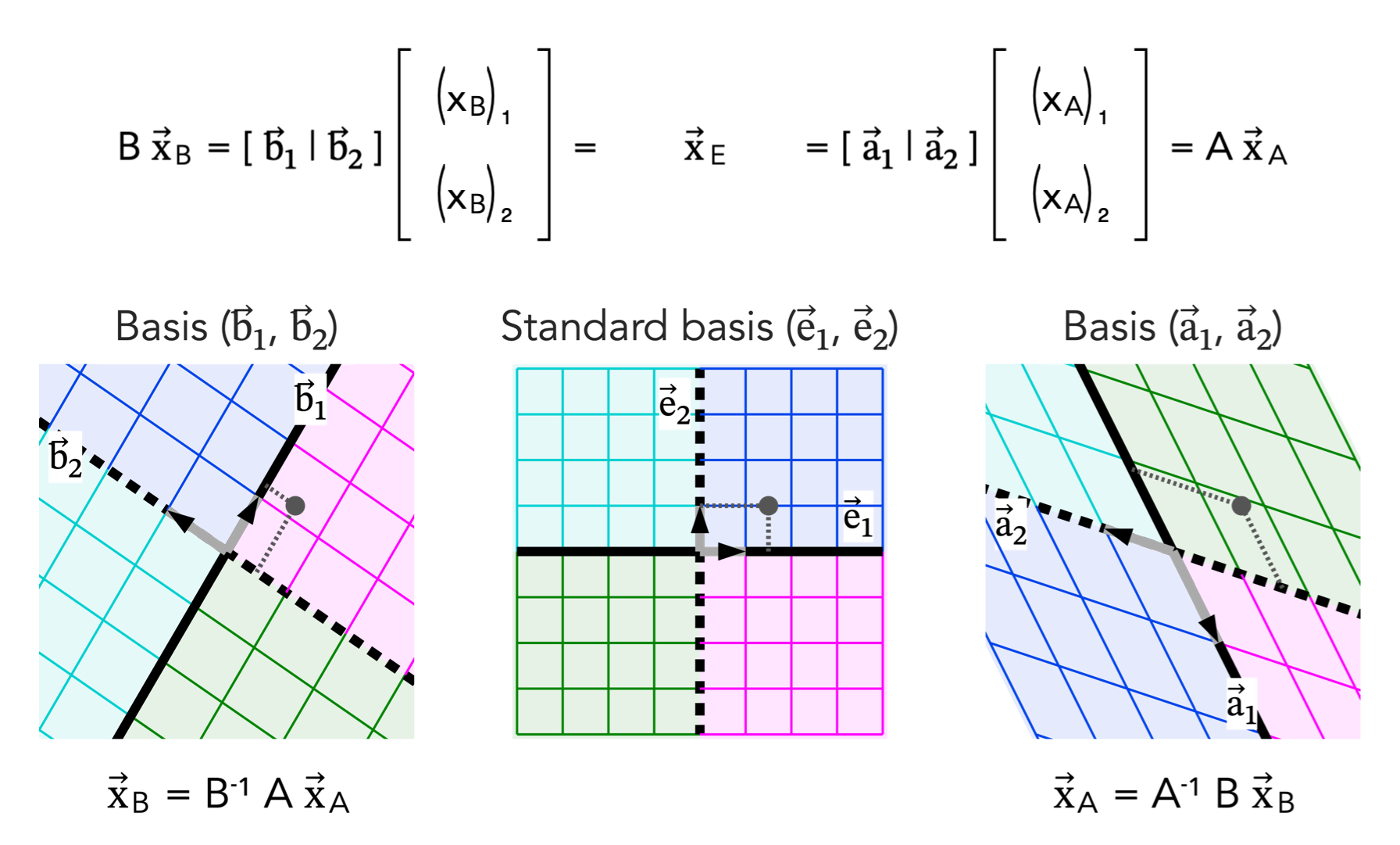
Changing coordinates between two bases
The same vector can be tracked across two nonstandard bases by passing through standard coordinates.
This makes the coordinate transformation explicit: xB = B−1A xA
and xA = A−1B xB.
Click the image to open the full-size version.
Concept
Let A = [a₁ | a₂] be the matrix whose columns are the vectors of one basis.
If xA is the coordinate column of a vector relative to that basis,
then the actual geometric vector in standard coordinates is x = A xA.
If B = [b₁ | b₂] is another basis matrix for the same space, then the same vector also satisfies
x = B xB. Since both expressions describe the same vector, their coordinates are related by a matrix transformation.
Structure
The key separation is between the vector itself and its coordinates.
A basis matrix reconstructs the vector from coordinates. A change-of-basis matrix converts one coordinate column into another.
This representation separates basis reconstruction from coordinate transformation explicitly.