Change of Basis — Derived from the Definition and Visualized
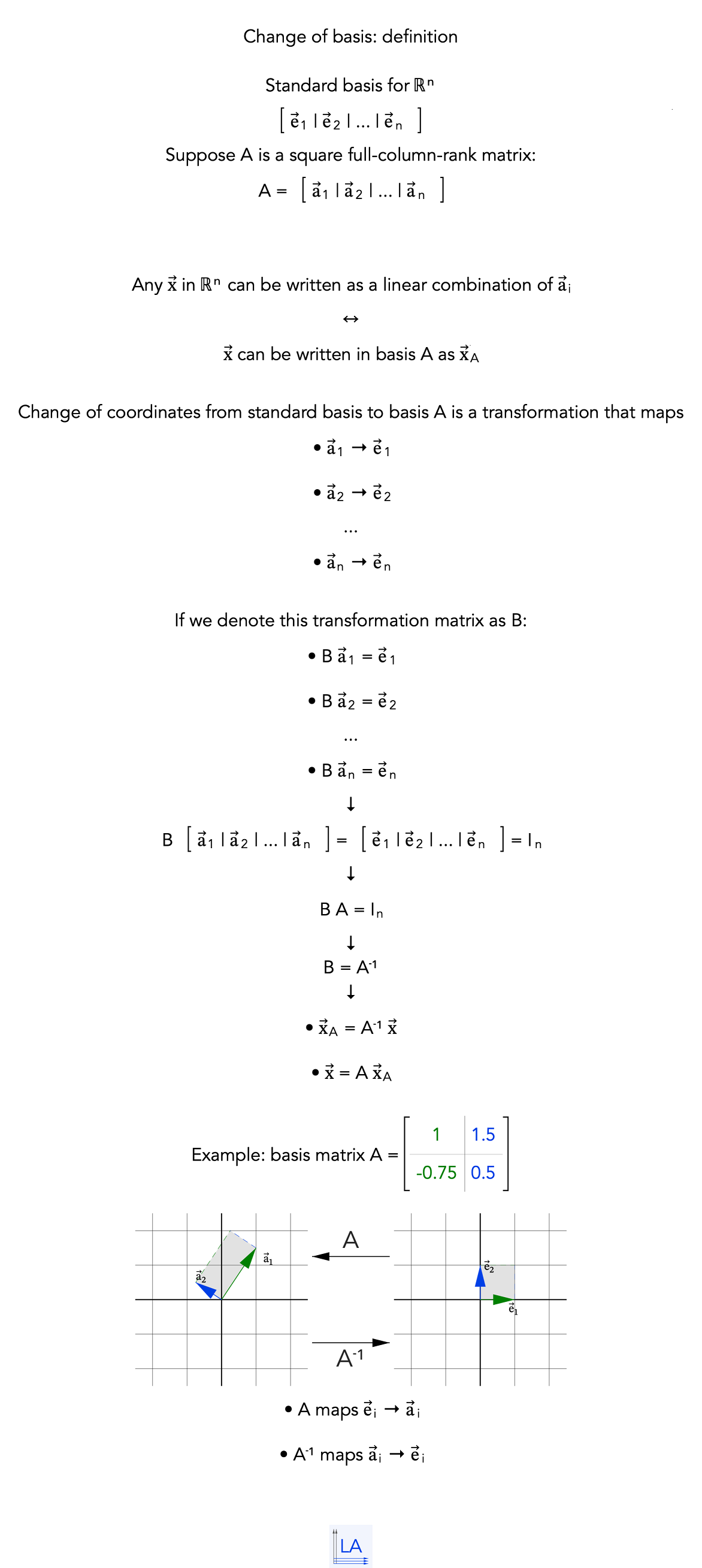
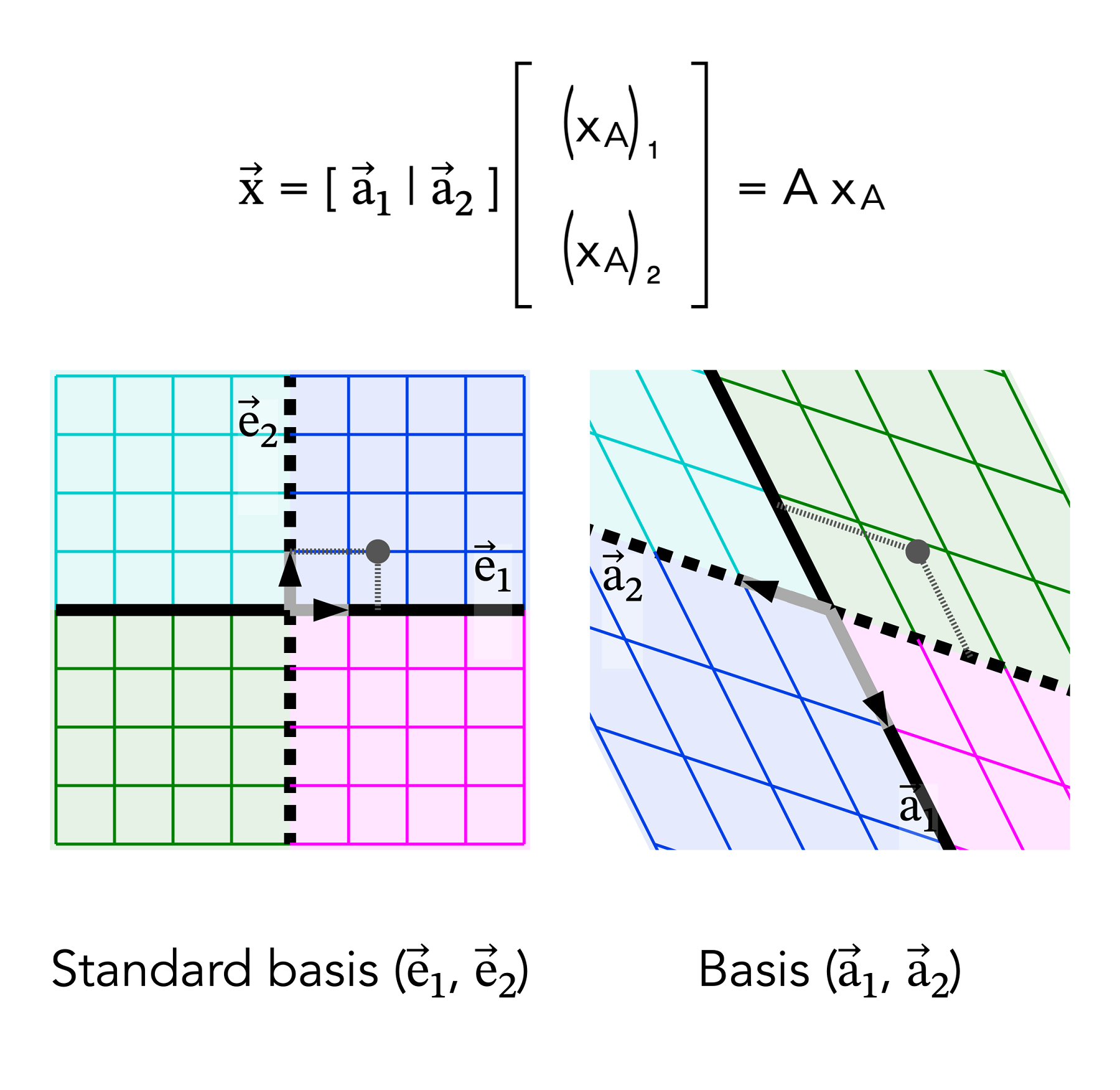
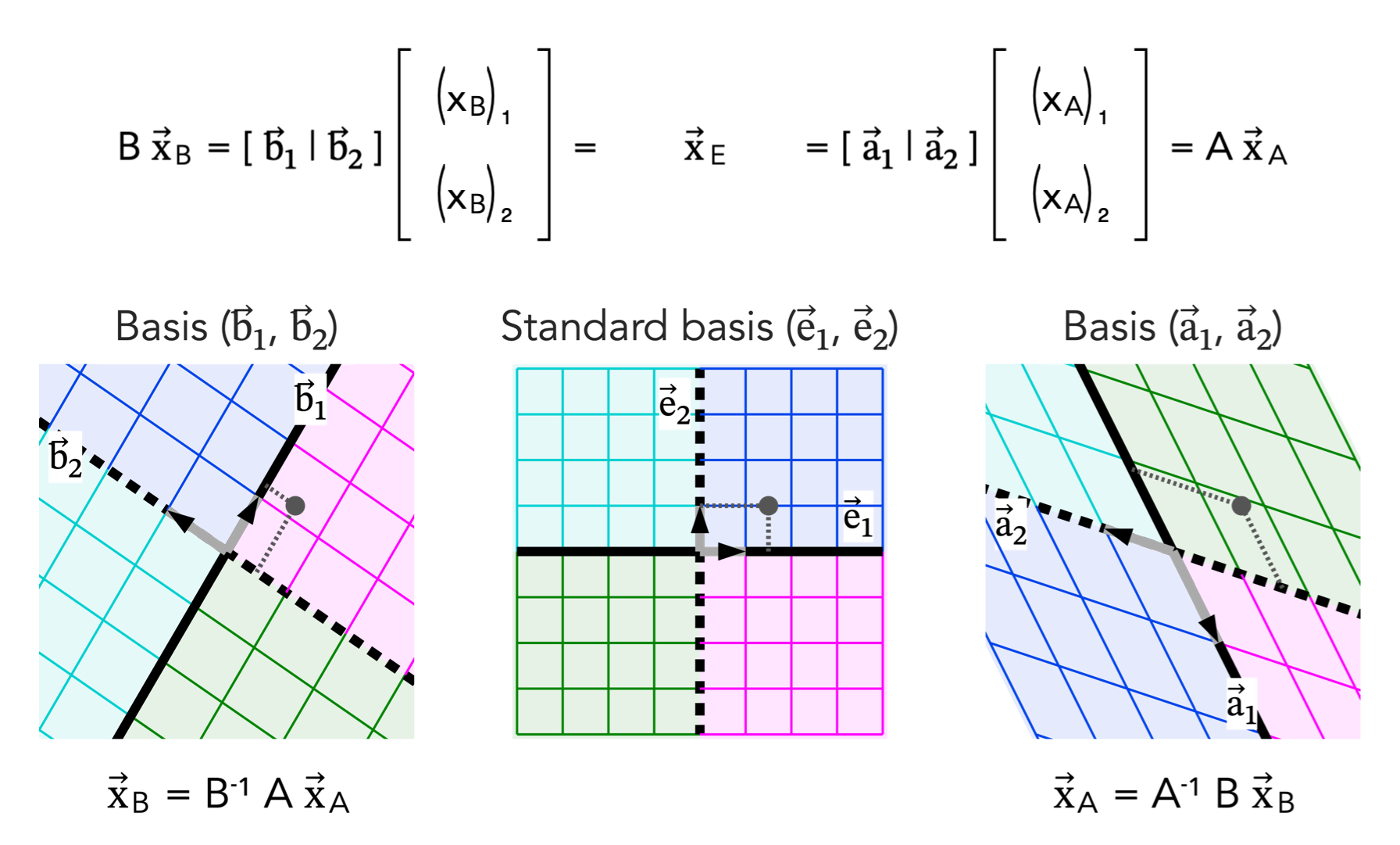
Change of basis does not change the vector itself. It changes only the coordinates used to describe that vector. The first image derives the coordinate-change matrix from the definition of a basis. The following images show the same vector represented first in the standard basis and then in another basis. The coordinate column changes because the basis vectors change, but the geometric vector in the plane remains the same.
Visual 1
Visual 2
Visual 3
Concept
Let A = [a₁ | a₂ | ... | aₙ] be the matrix whose columns are the vectors of one basis. If xA is the coordinate column of a vector relative to that basis, then the actual geometric vector in standard coordinates is x = A xA.
If B = [b₁ | b₂] is another basis matrix for the same space, then the same vector also satisfies x = B xB. Since both expressions describe the same vector, their coordinates are related by a matrix transformation.
Structure
The key separation is between the vector itself and its coordinates. A basis matrix reconstructs the vector from coordinates. A change-of-basis matrix converts one coordinate column into another.
This representation separates basis reconstruction from coordinate transformation explicitly.
Key equations
The matrices A and B map coordinates into the same ambient vector space. The products B⁻¹A and A⁻¹B do something different: they convert one coordinate description into another.
Query phrases
- change of basis derived from the definition
- change of basis visualization
- change of basis coordinate mapping view
- what does x = A xA mean
- coordinate transformation between bases
- xB = B inverse A xA meaning
- change of basis through standard coordinates
Reference
External reference: Wikipedia — Change of basis